Shahmaran : The Serpent Queen
Listen
At a glance
| Description | |
|---|---|
| Origin | Central Asian Mythology |
| Classification | Gods |
| Family Members | N/A |
| Region | Turkey, Iran |
| Associated With | Wisdom, Healing Abilities, Prophetic Insight |
Shahmaran
Introduction
Shahmaran, often referred to as the “Queen of Snakes,” is one of the most captivating figures in Middle Eastern folklore, with roots in Kurdish, Persian, and Turkish mythology. The name comes from Persian—Shāh meaning “king” and mārān meaning “snakes”—though her representation is unmistakably feminine, making her the queen of serpents. Her myth spans the cultural landscapes of Anatolia, Mesopotamia, and the Iranian plateau, where she is celebrated as a symbol of wisdom, transformation, and mystery. The story of Shahmaran has been passed down through oral traditions, ancient manuscripts, and art, reflecting the deep connection between humans and nature’s hidden realms. Whether depicted as a benevolent protector or a tragic figure betrayed by human greed, Shahmaran continues to embody the timeless conflict between knowledge and ignorance, purity and corruption.
Physical Traits
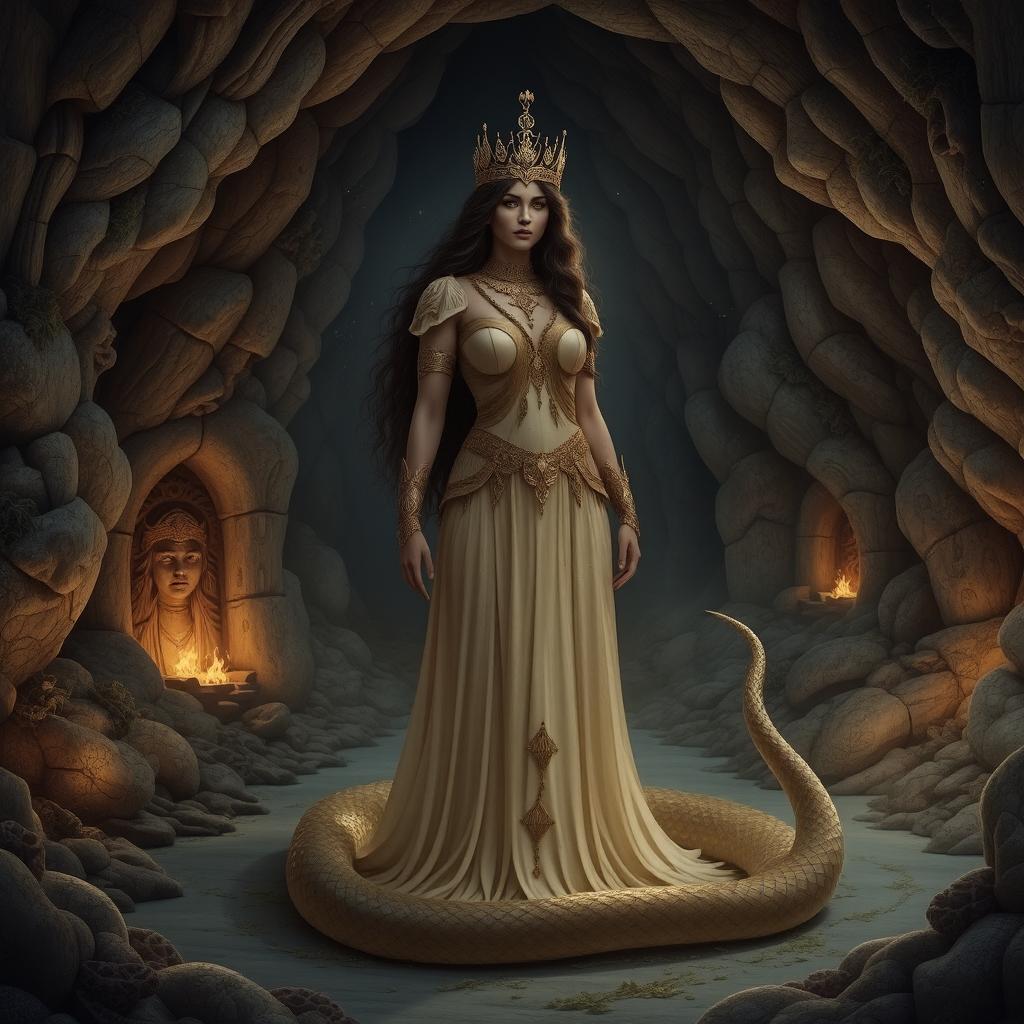
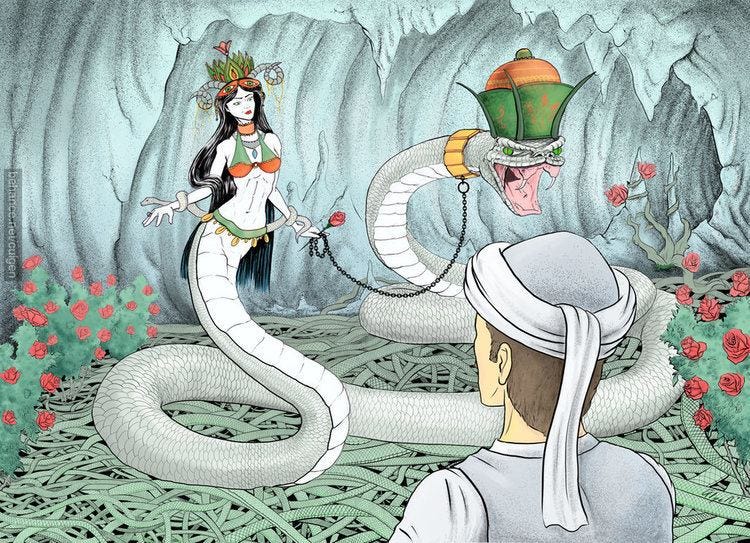
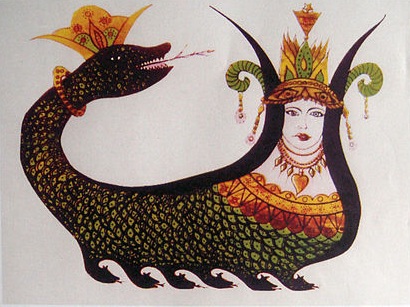
In art and folklore, Shahmaran is portrayed as an ethereal hybrid with the upper body of a stunning woman and the lower body of a serpent. This dual form symbolizes her mastery over both the human and natural worlds. Her face radiates serenity and intelligence, often crowned with jewels and golden ornaments that signify her royal and divine status. In many depictions, her serpentine tail coils gracefully around her body, representing both protection and latent power. Some regional variations describe her with two heads—one human and one serpent—each wearing a crown, emphasizing her dominion over wisdom and instinct alike. Unlike monstrous depictions of serpents in other myths, Shahmaran’s beauty and poise evoke reverence rather than fear. Her serpent form is not a curse but a sacred connection to nature and immortality.
Family
Shahmaran’s legend does not focus on a human-like family but rather on her spiritual kinship with the serpents she governs. She is described as the queen of an underground kingdom inhabited by thousands of peaceful, intelligent snakes who live in harmony under her rule. This subterranean paradise symbolizes both the hidden world of wisdom and the secrets buried within the earth. Human involvement in her story usually begins when a young man—known variously as Tahmasp, Jamasp, or Hasib—discovers her hidden realm. Their relationship, sometimes one of love and sometimes of mentorship, ultimately ends in betrayal when he reveals her existence to the human world. Her death or sacrifice then becomes a profound allegory for the loss of innocence and the misuse of sacred knowledge. In some versions, her spirit passes to her daughter, suggesting a cyclical continuation of her power and wisdom through successive generations of serpent queens.
Other names
Shahmaran’s name changes subtly across regions and languages but always retains its symbolic power. In Persian, she is called Shāhmārān; in Turkish folklore, she becomes Şahmeran; and in Kurdish traditions, she is often referred to as Şahmaran or Shamaran. Each linguistic variation preserves her regal title while adapting her myth to local beliefs. The meaning of her name—“King of Snakes”—is paradoxical yet poetic, reflecting the fusion of masculine and feminine qualities within her nature. Other epithets, such as “Mother of Snakes” or “Serpent Queen,” emphasize her nurturing yet authoritative role in serpent lore. Her presence in literature, including versions of The Arabian Nights and regional folktales like The Story of Hasib Karim al-Din, demonstrates how her legend transcended linguistic and cultural boundaries, merging mystical symbolism with moral lessons.
Powers and Abilities
At the core of Shahmaran’s legend lies her unparalleled wisdom and healing powers. She is a guardian of hidden knowledge, particularly of herbal medicine and alchemy. In many tales, she knows the secret properties of every plant and can cure diseases or extend life. Those who encounter her are often transformed—mentally, spiritually, or even physically—by her insight. Her body itself is believed to possess magical properties: consuming her flesh, blood, or essence is said to bestow extraordinary wisdom, eloquence, or even immortality. Yet, this act is always accompanied by moral consequences. In most versions of the tale, the human who betrays her does so at the behest of a greedy ruler seeking her secrets. When she dies, her wisdom is transferred to humanity, but her trust is forever broken. Her dual nature—both healer and avenger—reminds listeners that divine wisdom must be approached with humility, not exploitation.
Beyond myth, Shahmaran’s image also serves a protective role. In parts of Anatolia and Kurdistan, her likeness is painted on household walls or crafted into amulets to guard against evil spirits and illness. The serpent, a universal symbol of regeneration and renewal, reinforces her association with cycles of death and rebirth.
Modern Day Influence
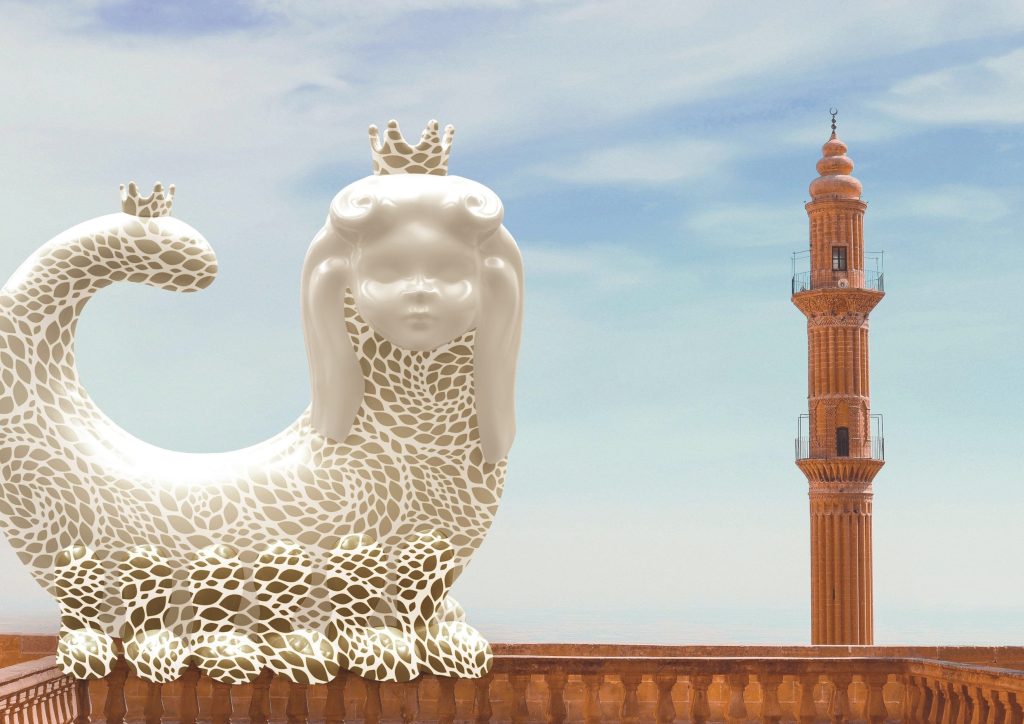
The mythology of Shahmaran continues to inspire and evolve in the modern era, particularly in art, literature, and social movements across the Middle East. Her image adorns textiles, ceramics, and public murals in regions such as Mardin, Tarsus, and Diyarbakır, where she remains a beloved emblem of wisdom and feminine strength. The city of Mardin, in particular, has embraced Shahmaran as its cultural guardian—hosting public art installations like the Shahmaran Mardin project, where artists reinterpret her in contemporary forms.
Shahmaran has also become a symbol of resistance and empowerment for women and marginalized groups. Kurdish and Turkish feminists reimagine her as a representation of female autonomy, intelligence, and defiance against patriarchal control. Her dual nature—a woman merged with a serpent—has made her a powerful icon for gender diversity and self-acceptance, resonating with LGBTQ+ communities in Turkey and beyond.
In modern media, Shahmaran’s influence extends into literature, music, and cinema. Iranian-Dutch singer Sevdaliza’s haunting song “Shahmaran” reinterprets her myth through a modern feminist lens, while the 2023 Netflix series Shahmaran adapts the legend into a contemporary fantasy narrative that explores identity, destiny, and forbidden love. In visual art, Kurdish painter and activist Zehra Doğan famously portrayed Shahmaran while imprisoned, using the colors of the Kurdish flag to symbolize resistance, wisdom, and rebirth.
Through these diverse expressions, Shahmaran has transcended her mythological roots to become a living symbol of cultural resilience. Her story—rooted in betrayal, wisdom, and transformation—continues to speak to universal human experiences of suffering, renewal, and the eternal quest for enlightenment.
Today, Shahmaran stands as more than a figure of myth; she represents the enduring spirit of knowledge and the power of transformation that bridges the ancient and the modern world. Her legend reminds us that truth, like the serpent, sheds its skin but never dies—renewing itself with every generation that dares to listen.
Related Images

 What Were Odin’s Riddles, and Why Were They Deadly?
 Akan Caribbean Mythology: African Beliefs That Crossed the Atlantic
 Why the Solar Solstice marked the most powerful days of the ancient world
 Solar Equinox in Ancient Belief: Light, Darkness and Divine Harmony
 Saptamatrika : The Seven Mother Goddesses Who Shape Cosmic Power
Source
Demir, L. (2023, July 7). Female Head Snake in Kurdish Mythology: Shahmaran. Hevsel Times. https://www.hevseltimes.org/post/female-head-snake-in-kurdish-mythology-shahmaran
BBC Reel (2024, July 11). Shahmaran: The mythical symbol inspiring Turkish artists. https://www.bbc.com/reel/video/p0j9t81p/shahmaran-the-mythical-symbol-inspiring-turkish-artists
“Shahmaran.” (n.d.). Wikipedia. https://en.wikipedia.org/wiki/Shahmaran
“Who Was Shahmaran? Lover, Trickster, Ancient Persian Snake Lady.” (2021, Sept. 6). Ancient Origins. https://www.ancient-origins.net/myths-legends-asia/shahmaran-0015789
“Göbekli Tepe and the Legend of the Shahmaran.” (2022, Nov. 2). Eastern Turkey Tour. https://www.easternturkeytour.org/gobekli-tepe-and-the-legend-of-the-shahmaran/
Shamaran in Kurdish Culture and Art. (2025, Jan. 30). Facebook. https://www.facebook.com/groups/rughub/posts/9065828813484198/
“Mythical queen of the snakes and popular symbol of Mardin.” (2018, Mar. 9). Alan Tatour. https://alantatour.net/shahmaran-story.html
Modares University Journal. “The Role of the Kurdish Myth of Shamaran in Shaping Kurdish Literature and Society.” https://cfl.modares.ac.ir/article_22131_en.html
Beeman, W. O. (2001). Iranian Performance Traditions. Mazda Publishers.
Yıldız, A. (2015). Şahmeran Motifinin Türk Kültüründeki Yeri. Turkish Folklore Studies Journal, 12(3), 45–58.
Moosa, M. (1988). Folklore and Myth in Iranian Culture. Middle East Journal, 42(2), 234–245.
Hassanpour, A. (1992). Nationalism and Language in Kurdistan, 1918–1985. Edwin Mellen Press.
Öztürk, M. (2019). Şahmeran Efsanesinin Sanat ve Mimariye Yansımaları. Journal of Anatolian Cultural Studies, 7(1), 89–102.
Frequently Asked Questions
What is lorem Ipsum?
I am text block. Click edit button to change this text. Lorem ipsum dolor sit amet, consectetur adipiscing elit. Ut elit tellus, luctus nec ullamcorper mattis, pulvinar dapibus leo.
What is lorem Ipsum?
I am text block. Click edit button to change this text. Lorem ipsum dolor sit amet, consectetur adipiscing elit. Ut elit tellus, luctus nec ullamcorper mattis, pulvinar dapibus leo.
What is lorem Ipsum?
I am text block. Click edit button to change this text. Lorem ipsum dolor sit amet, consectetur adipiscing elit. Ut elit tellus, luctus nec ullamcorper mattis, pulvinar dapibus leo.
What is lorem Ipsum?
I am text block. Click edit button to change this text. Lorem ipsum dolor sit amet, consectetur adipiscing elit. Ut elit tellus, luctus nec ullamcorper mattis, pulvinar dapibus leo.
What is lorem Ipsum?
I am text block. Click edit button to change this text. Lorem ipsum dolor sit amet, consectetur adipiscing elit. Ut elit tellus, luctus nec ullamcorper mattis, pulvinar dapibus leo.