Nahn Sapwe : The Thunder God of Pohnpei
Listen
At a glance
| Description | |
|---|---|
| Origin | Pohnpeian Mythology |
| Classification | Gods |
| Family Members | N/A |
| Region | Federated States of Micronesia |
| Associated With | Thunder |
Nahn Sapwe
Introduction
Nahn Sapwe stands as one of the most powerful and enduring figures in Pohnpeian mythology, originating from the island of Pohnpei in the Federated States of Micronesia. Revered primarily as a god of thunder, lightning, and cosmic authority, Nahn Sapwe occupies a central place in the island’s sacred history and political memory. His myths are inseparable from the rise and fall of the Saudeleur dynasty, whose foreign rule once dominated Pohnpei through the stone city of Nan Madol. In Pohnpeian oral tradition, Nahn Sapwe is not merely a storm deity but a divine force who intervenes in human affairs when balance is broken. His role as the spiritual father of Isokelekel, the culture hero who overthrew the Saudeleurs, transforms him into a symbol of resistance, legitimacy, and indigenous sovereignty. Through Nahn Sapwe, mythology becomes history, and divine power becomes the moral engine of social change.
Physical Traits
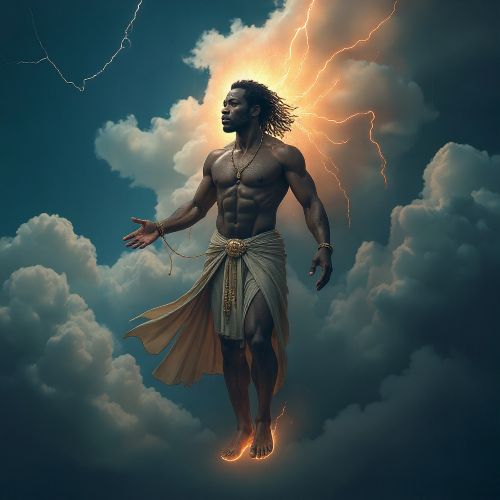
Unlike many mythological gods depicted in fixed human forms, Nahn Sapwe is defined by presence rather than appearance. Pohnpeian traditions describe him as an elemental being whose form is revealed through storms rather than flesh. Thunder is understood as his voice, lightning as his gaze or weapon, and dark storm clouds as his manifestation in the sky. Some accounts describe a vast, shadowed figure seated among clouds, radiant yet terrifying, whose arrival is announced by violent weather. These descriptions avoid anthropomorphism, emphasizing instead that Nahn Sapwe belongs to the sky world rather than the human realm. His lack of a stable physical body reinforces his role as a cosmic authority—felt everywhere, seen nowhere, and impossible to confine within human limits.
Family
Family lineage is essential to understanding Nahn Sapwe’s role in Pohnpeian mythology. He is closely linked to the Dipwenpahnmei clan, one of the most significant clans in Pohnpei’s social structure. His most important familial connection is with the mortal woman Lipahnmei, whom he impregnates through supernatural means while residing in the distant land of Katau Peidak. Their son, Isokelekel, becomes the pivotal figure who fulfills Nahn Sapwe’s divine intent by overthrowing the Saudeleur rulers. This relationship establishes Nahn Sapwe as both a god and a political ancestor, legitimizing new systems of leadership through divine descent. Through Isokelekel, Nahn Sapwe bridges the gap between the celestial and human worlds, ensuring that divine justice is enacted through mortal action.
Other names
Nahn Sapwe appears under several variations across Pohnpeian oral traditions, reflecting regional pronunciation and ritual emphasis rather than entirely separate identities. Names such as Nahnsapwe or Sapwe are common, often prefixed with honorifics that denote sacred authority. In some contexts, he is referred to simply as the Thunder God of Nan Madol, highlighting his direct opposition to the Saudeleur rulers who controlled the site. These variations do not fragment his identity but expand it, allowing different communities to emphasize specific aspects of his power—whether as a sky god, ancestral father, or divine avenger. The consistency of his core name across traditions underscores his prominence within Pohnpeian cosmology.
Powers and Abilities
Nahn Sapwe’s powers are primarily elemental, political, and generative. As a god of thunder and lightning, he commands the sky, using storms as expressions of approval or wrath. His control over weather is not arbitrary; it reflects moral judgment, punishing arrogance and injustice while protecting rightful order. Beyond storms, Nahn Sapwe possesses the ability to influence fertility and lineage, demonstrated through the miraculous conception of Isokelekel. He also exhibits foresight and strategic intelligence, withdrawing from Pohnpei when his worship is suppressed and orchestrating the Saudeleurs’ downfall from afar. His power is not expressed through constant intervention but through decisive moments that reshape history, making him a god of consequence rather than spectacle.
Modern Day Influence
Nahn Sapwe remains deeply embedded in Pohnpei’s cultural consciousness. His association with Nan Madol—now a UNESCO World Heritage Site—continues to attract scholars, storytellers, and cultural preservationists. Oral traditions recount his role during storms, reinforcing respect for natural forces and ancestral authority. In modern Pohnpei, Nahn Sapwe is increasingly viewed as a symbol of indigenous resistance, embodying the rejection of imposed rule and the restoration of native governance. His story is taught in schools, referenced in academic studies of Micronesian mythology, and reinterpreted in contemporary art and cultural revitalization movements. As climate change intensifies storms in the Pacific, Nahn Sapwe’s identity as a thunder god has gained renewed relevance, linking environmental awareness with ancestral belief. His enduring presence demonstrates how mythology continues to shape identity, memory, and resilience in the modern world.
Related Images
 What Were Odin’s Riddles, and Why Were They Deadly?
 Akan Caribbean Mythology: African Beliefs That Crossed the Atlantic
 Why the Solar Solstice marked the most powerful days of the ancient world
 Solar Equinox in Ancient Belief: Light, Darkness and Divine Harmony
 Saptamatrika : The Seven Mother Goddesses Who Shape Cosmic Power




Source
Ayres, W. S. (1990). Pohnpei’s position in eastern Micronesian prehistory. Micronesian Endowment for Historic Preservation.
Bascom, W. R. (1965). Ponape: A Pacific economy in transition. University of California Anthropological Records.
Hadley, D., & Maurer, W. H. (1987). Upon a stone altar: A history of the island of Pohnpei to 1890. University of Hawaii Press.
National Park Service. (2020). Nan Madol. https://www.nps.gov/places/nan-madol.htm
Pohnpei Adventure. (2013). A history of Nan Madol. https://www.pohnpei-adventure.com/tag/pahn-nahkapw/
UNESCO. (2015). Nan Madol: Ceremonial centre of eastern Micronesia. https://whc.unesco.org/en/list/1503/
Wikipedia contributors. (2024). Isokelekel. Wikipedia. https://en.wikipedia.org/wiki/Isokelekel
Wikipedia contributors. (2024). Saudeleur dynasty. Wikipedia. https://en.wikipedia.org/wiki/Saudeleur_dynasty
Frequently Asked Questions
Who is Nahn Sapwe in Pohnpeian mythology?
Nahn Sapwe is the thunder god of Pohnpei and a central divine figure linked to storms, justice, and the fall of the Saudeleur dynasty.
Is Nahn Sapwe connected to Nan Madol?
Yes, Nahn Sapwe is closely associated with Nan Madol, where his worship conflicted with Saudeleur rule and influenced its eventual collapse.
Is Nahn Sapwe still important today?
Yes, he remains a powerful symbol of cultural identity, resistance, and environmental respect in modern Pohnpei.
Who was Isokelekel in relation to Nahn Sapwe?
Isokelekel is the semi-divine son of Nahn Sapwe who led the successful rebellion against the Saudeleurs.
What powers does Nahn Sapwe possess?
He controls thunder and lightning, influences lineage and fertility, and intervenes in human affairs to restore cosmic balance.