Song of the Sea (2014)
| Description | |
|---|---|
| Country of Origin | Ireland |
| Language | English |
| Genre | Animated |
| Cast | David Rawle, Brendan Gleeson, Fionnula Flanagan, Lisa Hannigan, Pat Shortt |
| Directed by | Tomm Moore |
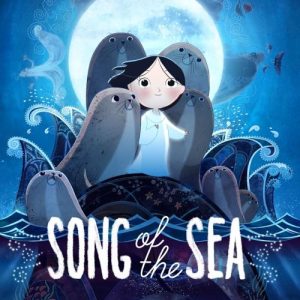
Tomm Moore’s Song of the Sea (2014) is a hauntingly beautiful Irish animated film that captures the essence of Celtic mythology while telling a deeply human story about love, loss, and the magic hidden in everyday life. Produced by Cartoon Saloon, the film follows the story of Ben and his mute younger sister, Saoirse, who turns out to be a selkie — a mythical being from Irish folklore capable of transforming from a seal into a human. Through their journey, Song of the Sea breathes new life into Ireland’s mythic past, wrapping it in hand-painted animation and a story that feels both timeless and contemporary.
At its core, Song of the Sea is a love letter to the mythic traditions of Ireland. The selkie legend, which lies at the heart of the movie, has long been a cornerstone of Celtic storytelling — tales of sea spirits who straddle the worlds of land and ocean, bound by their sealskins. Saoirse embodies this duality, representing the fragile connection between humanity and nature. Her transformation into a selkie and her magical song are more than narrative devices; they symbolize Ireland’s own struggle to preserve its folklore amid the tides of modernity.
The film skillfully integrates other mythological elements without overwhelming the audience. The Great Seanachaí, a giant with a flowing beard made of swirling hair that stores memories, embodies the role of the traditional Irish storyteller, preserving the wisdom of ages. His character mirrors the fading oral traditions that once kept myths alive across rural Ireland. Then there’s Macha, the owl witch, inspired by the Morrígan — a goddess associated with fate and transformation. Macha’s attempts to suppress emotions by turning them into stone reflect humanity’s tendency to bury pain rather than face it, making her both a tragic and symbolic figure. Each mythical entity in Song of the Sea carries an emotional truth, blending folklore with themes of healing, family, and remembrance.
What makes Song of the Sea exceptional among modern animated films is its authenticity in portraying Irish mythology not as fantasy, but as a living, breathing world intertwined with reality. The mystical and mundane coexist naturally; the rugged coastal landscapes, ancient stone circles, and haunting lullabies evoke the folklore’s deep connection to Ireland’s geography and language. The Gaelic-inspired score by Bruno Coulais and Irish folk group Kíla amplifies this feeling, weaving music and myth into a unified emotional experience. The selkie song itself acts as a bridge — a call that unites the human and spirit worlds, a reminder of the sacred harmony that once existed between them.
The film’s mythological symbolism extends to its visual storytelling. The use of circular patterns and spirals throughout the animation recalls ancient Celtic art and stone carvings, subtly reminding viewers that these stories are carved into Ireland’s cultural DNA. Even the color palette reflects the natural world’s spiritual energy — deep ocean blues, mossy greens, and the warm glow of lantern light evoke both the comfort and mystery of folklore. The sea, ever-present and alive, becomes a character in itself — the eternal keeper of stories, secrets, and songs.
Tomm Moore’s storytelling is not about glorifying myth but about showing its relevance in modern life. The city scenes, filled with concrete and radio noise, feel starkly disconnected from the mystical landscapes of the west coast. This contrast highlights how the loss of myth is also the loss of imagination and emotional truth. Ben’s journey from disbelief to acceptance of his sister’s nature mirrors a collective rediscovery of faith in the unseen — a belief that stories and traditions carry healing power. Through Saoirse’s selkie song, the film reminds viewers that mythology isn’t just a relic of the past; it’s a vessel for emotional expression and cultural survival.
The emotional impact of Song of the Sea lies in how it uses myth to explore universal human experiences. The legends are not distant or abstract — they are metaphors for grief, love, and reconciliation. The children’s loss of their mother, who was also a selkie, is mirrored in the mythic imbalance between the worlds of humans and spirits. Only through embracing her selkie heritage can Saoirse restore harmony and release the trapped fairies, representing the restoration of emotional wholeness and the return of forgotten stories. In this way, mythology becomes both literal and therapeutic — a spiritual map leading the characters, and the audience, back to connection.
Beyond its folkloric depth, Song of the Sea has been praised for its delicate balance between sorrow and hope. It never shies away from emotional complexity, much like the myths that inspired it. The selkies’ melancholy songs and the fairies’ longing for freedom echo the Irish oral tradition of blending joy and tragedy, laughter and lament — a balance that defines the Irish mythic worldview. Through this, the film achieves what few animated works manage: a spiritual resonance that transcends age, culture, and genre.
In the broader context of myth-based cinema, Song of the Sea stands as a modern classic. While Hollywood often adapts folklore for spectacle, Moore and his team present it with reverence and poetic subtlety. The film’s success lies not in its use of magic but in its understanding that myth is an extension of human emotion. The selkie story, in particular, speaks to themes of identity, belonging, and transformation — making Song of the Sea a deeply Irish yet universally relatable tale.
Ultimately, Song of the Sea is more than a film — it is a preservation of Ireland’s soul. Its mythological framework, interwoven with breathtaking artistry, ensures that ancient Celtic legends remain alive in the hearts of modern audiences. Through Saoirse’s song, the film invites viewers to remember the importance of storytelling — the song that keeps cultures alive, the melody that carries memory across generations. As the waves close over the final scene, one feels that Song of the Sea has not just told a myth but revived one, reminding us that even in a modern world, magic still hums beneath the surface, waiting to be heard.