Iku-Turso : The Eternal Sea Monster
Listen
At a glance
| Description | |
|---|---|
| Origin | Finnish Mythology |
| Classification | Animals |
| Family Members | N/A |
| Region | Finland |
| Associated With | Death, Sea Attacks, Whirlpools |
Iku-Turso
Introduction
In the frozen expanse of Finnish mythology, few beings inspire as much awe and terror as Iku-Turso, the primordial sea monster of chaos and destruction. Often portrayed as a force of war, pestilence, and calamity, Iku-Turso occupies a significant role in the Finnish mythological cosmos. His name appears in the Kalevala—Finland’s national epic—and in ancient spells and runes, where he is feared as the embodiment of untamed oceanic power. While his origins are ancient and somewhat elusive, the legends of Iku-Turso reveal the Finns’ deep respect for the mysterious and destructive forces of nature. His myth stands as a bridge between the human world and the deep, unknowable darkness of the sea, representing both the dangers of chaos and the necessity of balance in the natural order.
Physical Traits
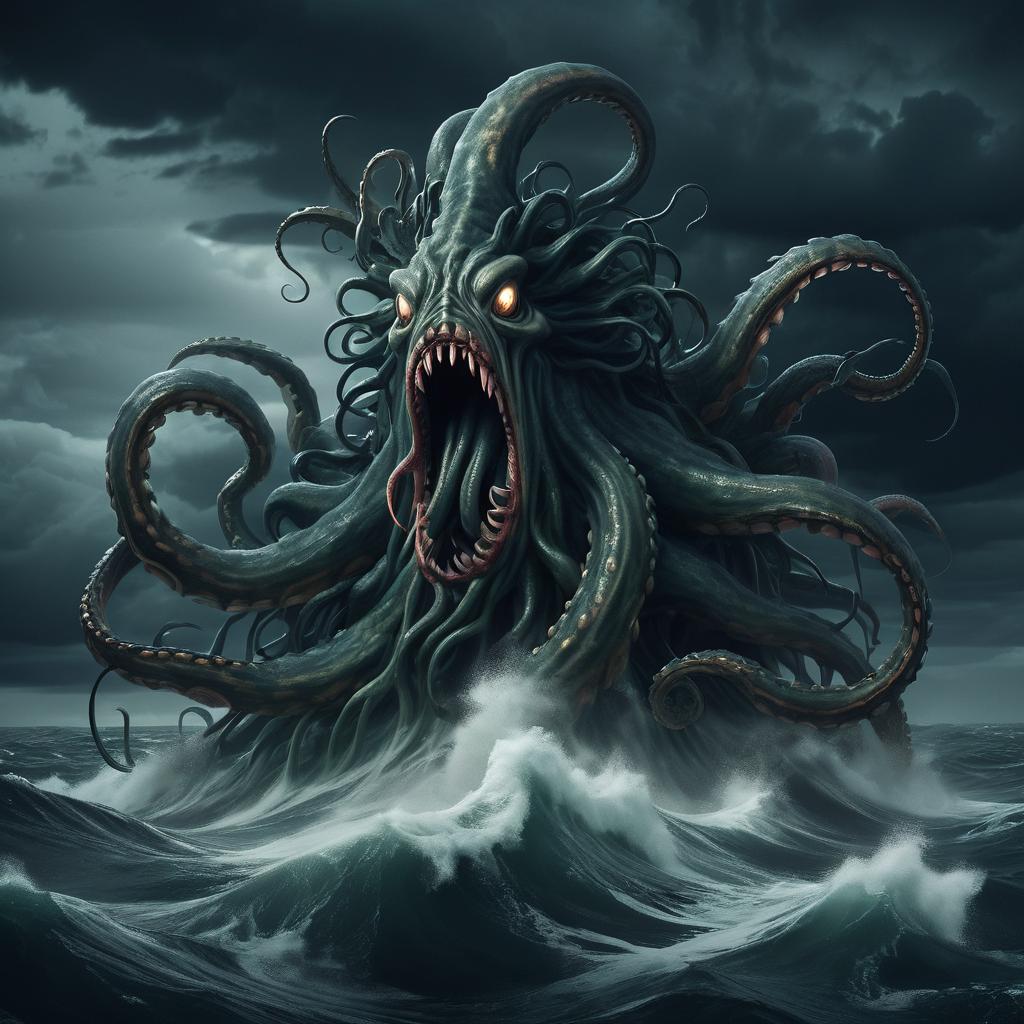
Descriptions of Iku-Turso’s appearance vary widely, reflecting the oral and evolving nature of Finnish mythology. In many depictions, he rises from the sea as a colossal creature covered in scales, with horns, tentacles, and multiple heads—an image that blends both aquatic and monstrous traits. He is often called Tuhatpää, meaning “the thousand-headed,” and Tuhatsarvi, meaning “the thousand-horned,” suggesting an overwhelming, almost cosmic monstrosity. Some versions liken him to a walrus, while others describe him as resembling an octopus or kraken, possessing limbs that can crush ships and drag warriors beneath the waves. Another epithet, Partalainen—“the bearded one” or “the border dweller”—may refer to his ancient and liminal nature, existing between the realms of life and death, land and sea. These diverse portrayals emphasize Iku-Turso’s function not as a single identifiable creature but as a symbol of nature’s unpredictable might and the deep fear of the unknown waters that surrounded ancient Finland.
Family
The genealogies of Iku-Turso differ across sources, but each version underscores his immense mythological importance. In one well-known myth, Iku-Turso mates with Loviatar, the blind daughter of Tuoni, god of the underworld, and their union produces the Nine Diseases—each representing a form of suffering inflicted upon humanity. This connection ties Iku-Turso to pestilence and the darker forces governing human fate. Other legends suggest he may have fathered Väinämöinen, the sage-hero of the Kalevala, through his union with Ilmatar, the Virgin of the Air. This alternate lineage associates him with creation and the birth of wisdom, reflecting the duality of his role as both destroyer and progenitor. In some traditions, Iku-Turso is referred to as the son of Äijö (another name for Ukko, the sky god), situating him among the divine hierarchy of Finnish deities. These shifting family ties mirror the fluid structure of Finnish mythology, where gods, spirits, and monsters often overlap in function and symbolism.
Other names
Iku-Turso is known by several names and variations throughout Finland’s folklore, each revealing a different aspect of his identity. Among these are Iku-Tursas, Iki-Tursas, Meritursas (“Sea Tursas”), Tursas, and Turisas. The name Turisas was famously listed by Mikael Agricola in 1551 as the Finnish god of war, linking Iku-Turso to martial power and divine wrath. Linguists trace the root of “Turso” or “Tursas” to the Proto-Germanic Þurisaz, meaning “giant” or “demon,” suggesting ancient Indo-European origins for the myth. The name Meritursas also survives in modern Finnish as a poetic term for an octopus, although the modern word mustekala (“ink fish”) has largely replaced it. These multiple names reflect both regional storytelling traditions and the evolution of myth through language, showing how Iku-Turso’s legend transformed over centuries from an ancient sea spirit into a figure of cosmic dread and warfare.
Powers and Abilities
The powers attributed to Iku-Turso highlight his status as a deity of chaos and destruction. He commands the seas, summoning storms and whirlpools that wreck ships and swallow entire fleets. He can burn fields and forests, as described in the Kalevala, where he emerges from the depths to set fire to a haystack, from which a massive oak tree grows—so tall it threatens to obscure the sun and moon. His dominion over pestilence is equally feared; he is said to have created diseases alongside Loviatar, spreading illness through the world. In spells and incantations, Iku-Turso is invoked as the “ox of Tuoni,” a being of deathly strength who cannot be defeated by mortal means. Some stories describe his control over aquatic movement, granting him extraordinary speed—swift enough to glide through the ocean at impossible velocities. He is also linked to the power of curses, capable of inflicting madness and rage on those who cross his path. In one of his final appearances in the Kalevala, Iku-Turso is summoned by Louhi, the Mistress of the North, to guard the mystical artifact Sampo. Yet even he cannot stand against Väinämöinen’s magic and is ultimately banished to the depths, condemned never to rise again. This defeat symbolizes the triumph of order and wisdom over chaos and destruction.
Modern Day Influence
Though born of ancient myth, Iku-Turso’s presence endures in modern Finnish culture, art, and identity. His name has been revived across various forms of media, symbolizing power, mystery, and the untamed spirit of the sea. The Finnish Navy honored him by naming a World War II submarine Vesikko-class Iku-Turso, signifying vigilance beneath the waves. An asteroid discovered in 1942 was also christened 2828 Iku-Turso, carrying his mythic legacy into the stars. In contemporary music, his image resonates strongly in Finland’s thriving metal scene—bands like Turisas and Iku-Turso (a Finnish-Dutch black metal project formed in 2017) draw inspiration from his legend, weaving his chaos and majesty into their art. The creature’s likeness appears in video games such as Fear & Hunger 2: Termina, where it serves as a sleeping guardian rather than a destroyer, reflecting modern reinterpretations of the myth.
Beyond entertainment, Iku-Turso continues to influence Finnish symbolism. The tursaansydän, or “heart of Tursas,” remains a traditional protective emblem found in carvings and jewelry, believed to ward off evil. Artists and tattooists frequently depict Iku-Turso as a serpentine or tentacled god rising from turbulent waters, blending myth with modern aesthetics. To many, he represents the wild, unpredictable power of nature and the endurance of Finnish spirit—a reminder of the world’s untamable mysteries. Through these reimaginings, Iku-Turso transcends myth to become an enduring emblem of resistance, transformation, and the eternal struggle between chaos and order.
Related Images
 What Were Odin’s Riddles, and Why Were They Deadly?
 Akan Caribbean Mythology: African Beliefs That Crossed the Atlantic
 Why the Solar Solstice marked the most powerful days of the ancient world
 Solar Equinox in Ancient Belief: Light, Darkness and Divine Harmony
 Saptamatrika : The Seven Mother Goddesses Who Shape Cosmic Power

Source
Wikipedia contributors. (2025). Iku-Turso (creature). Wikipedia. https://en.wikipedia.org/wiki/Iku-Turso_(creature)[1]
FabulaHub. (2025, September 7). The Legend of the Iku-Turso: The Horned Terror of the Baltic. https://fabulahub.com/en/story/legend-of-iku-turso-horned-sea-monster-finland/sid-2339
Old World Gods. (2023, November 27). Iku Turso: Exploring the Myths and Legends of Finnish Mythology. https://oldworldgods.com/finnish/iku-turso-mythology/
Crossover Universe Amino. (2022, December 9). Iku-Turso | Wiki | Crossover Universe! Amino. https://aminoapps.com/c/crossoveruniverse/page/item/iku-turso/DZzx_BDINILBBBoqqlkwLzQVropwlgBVEG
Ferrebeekeeper. (2015, June 10). Inku-Turso | ferrebeekeeper – WordPress.com. https://ferrebeekeeper.wordpress.com/2015/06/11/inku-turso/
Frog, M., Mäkelä, H. H., Ahola, J., Karlsson, T., Kohonen, S., Barber, J. B., & Lukin, K. (2023). From Proto-Germanic *þur(i)saz to Karelian Iku Turso: A Case of Mythology, Language and the Lived Environment I: Proto-Germanic þur(i)saz. RMN Newsletter, 17, 20–43.
Arcanebeastsandcritters.wordpress.com. (2018, June 2). Iku-Turso – The Compendium of Arcane Beasts and Critters. https://arcanebeastsandcritters.wordpress.com/2018/06/03/iku-turso/
Monstropedia. (n.d.). Iku-Turso. https://www.monstropedia.org/index.php?title=Iku-Turso
Siikala, A.-L. (2002). Mythic Images and Shamanism: A Perspective on Kalevala Poetry. Finnish Literature Society.
Haavio, M. (1967). Suomalainen mytologia [Finnish Mythology]. WSOY.
Pentikäinen, J. (1999). Kalevala Mythology. Indiana University Press.
Honko, L. (1993). Religion, Myth, and Folklore in the World’s Epics. De Gruyter.
Frequently Asked Questions
What is lorem Ipsum?
I am text block. Click edit button to change this text. Lorem ipsum dolor sit amet, consectetur adipiscing elit. Ut elit tellus, luctus nec ullamcorper mattis, pulvinar dapibus leo.
What is lorem Ipsum?
I am text block. Click edit button to change this text. Lorem ipsum dolor sit amet, consectetur adipiscing elit. Ut elit tellus, luctus nec ullamcorper mattis, pulvinar dapibus leo.
What is lorem Ipsum?
I am text block. Click edit button to change this text. Lorem ipsum dolor sit amet, consectetur adipiscing elit. Ut elit tellus, luctus nec ullamcorper mattis, pulvinar dapibus leo.
What is lorem Ipsum?
I am text block. Click edit button to change this text. Lorem ipsum dolor sit amet, consectetur adipiscing elit. Ut elit tellus, luctus nec ullamcorper mattis, pulvinar dapibus leo.
What is lorem Ipsum?
I am text block. Click edit button to change this text. Lorem ipsum dolor sit amet, consectetur adipiscing elit. Ut elit tellus, luctus nec ullamcorper mattis, pulvinar dapibus leo.