Enumclaw : The Mythic Thunder Power of the Coast Salish
Listen
At a glance
| Description | |
|---|---|
| Origin | Coast Salish Mythology |
| Classification | Mortals |
| Family Members | Kapoonis (Brother) |
| Region | United States of America, Canada |
| Associated With | Thunder |
Enumclaw
Introduction
Enumclaw occupies a central place in Coast Salish mythology as a thunder spirit whose origins begin in the human world and end in the realm of elemental power. His story forms part of the broader spiritual landscape of the Pacific Northwest, where natural forces are not merely environmental phenomena but conscious presences woven into ancestral knowledge. Enumclaw, often paired with his twin Kapoonis, represents the booming power of thunder, a transformation gifted by Sky Father after the twins showed remarkable, almost dangerous mastery over their respective elemental talents. As a figure tied deeply to the rhythms of storms, Enumclaw reflects the core Salish belief that humans and the forces of nature are connected through stories that explain, respect, and personify the world around them. His tale endures because it communicates themes of ambition, transformation, and the careful balance required when interacting with powers greater than oneself.
Physical Traits
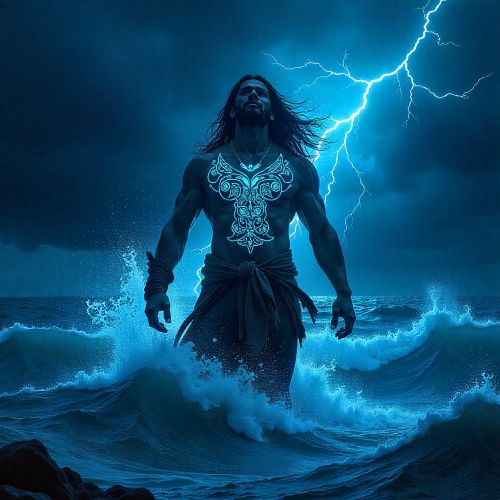
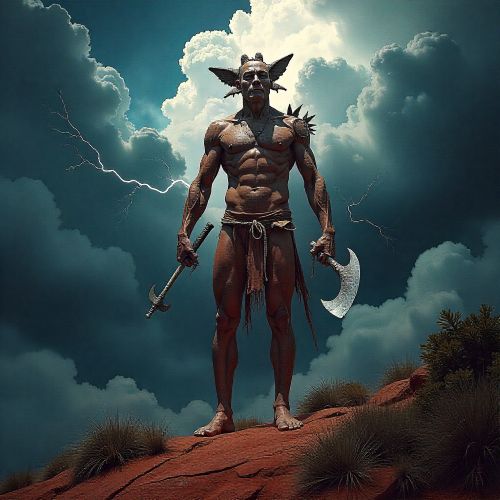
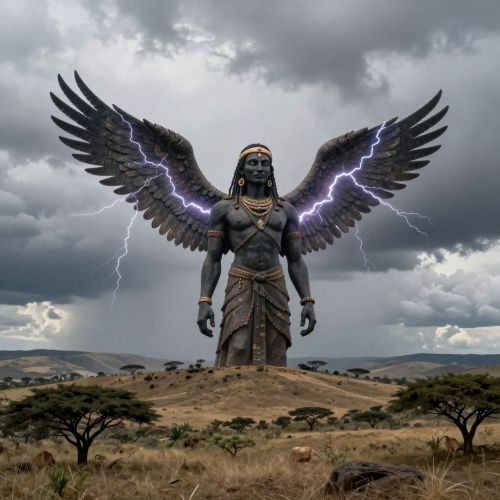
Descriptions of Enumclaw rarely focus on a fixed human-like appearance. Instead, he is understood as a being shaped by thunder’s intensity, strength, and echoing presence. Before his transformation, Enumclaw is described as a highly skilled youth whose unmatched rock-throwing produced explosive sounds that mirrored the sky’s rumble. After becoming the thunder spirit, his form becomes less corporeal; his presence is recognized not through visuals but through the deep roll of storm clouds and the shaking power that accompanies thunder. This shift from human to elemental being emphasizes his role as part of the natural world rather than a purely anthropomorphic deity. In many Coast Salish narratives, spirits assume forms tied to their purpose, and Enumclaw’s transformation into an embodiment of thunder reflects an identity inseparable from the atmosphere itself.
Family
A defining element of Enumclaw’s story is his bond with Kapoonis, his twin brother. The twins are inseparable in Salish tradition, representing complementary aspects of storm energy—Enumclaw as thunder, Kapoonis as lightning. Their early lives involve seeking power through ritual and training to become medicine men, demonstrating their shared ambition and deep spiritual aspirations. While their rivalry pushes them to excel, it is their combined abilities that capture the attention of Sky Father, who ultimately transforms them into the spirits governing storms. Their relationship aligns with the widespread Indigenous motif of divine or semi-divine twins whose combined existence maintains cosmic balance. For the Coast Salish peoples, the twins reflect the intertwined forces of nature—thunder following lightning, sound following light—each meaningful on its own but more complete together.
Other names
The name Enumclaw is the most commonly used today, especially due to its preservation in place names such as Enumclaw, Washington. In Coast Salish oral traditions, however, names often vary by language group and region, and Enumclaw may be identified more by his role than by a specific personal name. When referred to as “Thunder Spirit,” the focus shifts from individual identity to elemental function, reinforcing his role as a force rather than a figure. The survival of the name Enumclaw in modern geography highlights the enduring presence of Salish cultural memory embedded in the landscape. Place-naming acts as a form of storytelling, ensuring that sacred beings remain part of lived experience, even as communities evolve over generations.
Powers and Abilities
Enumclaw’s abilities emerge from both his human talent and his divine transformation. His original gift—throwing rocks with such precision and force that they recreated the sound of thunder—serves as the foundation of his spiritual identity. After being transformed by Sky Father, these rock-striking sounds become actual thunderclaps across the sky. As a thunder spirit, Enumclaw controls the booming resonance of storms, announcing the arrival of rain and signaling shifts in weather. In Coast Salish cosmology, thunder is not merely noise but a powerful, purposeful force that shapes the natural world, influences hunting and travel, and reminds humans of powers beyond their control. Enumclaw embodies this duality: thunder as both life-bringing and potentially destructive. His presence in the sky affirms the Salish understanding that spirits guide natural cycles and protect ecological balance.
Modern Day Influence
The legacy of Enumclaw continues into the present, particularly in the Pacific Northwest where Indigenous cultural revival efforts emphasize reconnecting with ancestral stories. The city of Enumclaw serves as a tangible reminder of the region’s Salish heritage, linking contemporary identity with ancient myth. In cultural education, Enumclaw appears in discussions about Indigenous environmental knowledge, traditional storytelling practices, and the importance of understanding the world through relationships rather than domination. Artists and writers draw inspiration from the myth of the thunder spirit, integrating him into contemporary interpretations of nature and spirituality. Modern comparisons also link Enumclaw to other thunder beings across North America, such as the Cherokee thunder beings or the widespread Thunderbird, revealing shared themes of sound, storm, and cosmic responsibility. Today, Enumclaw symbolizes not only mythic power but the enduring connection between people and the land—a theme increasingly relevant as communities advocate for ecological protection rooted in Indigenous perspectives.
Related Images
 What Were Odin’s Riddles, and Why Were They Deadly?
 Akan Caribbean Mythology: African Beliefs That Crossed the Atlantic
 Why the Solar Solstice marked the most powerful days of the ancient world
 Solar Equinox in Ancient Belief: Light, Darkness and Divine Harmony
 Saptamatrika : The Seven Mother Goddesses Who Shape Cosmic Power




Source
Wikipedia contributors. (2023, September 23). Enumclaw and Kapoonis. Wikipedia. https://en.wikipedia.org/wiki/Enumclaw_and_Kapoonis
New World Encyclopedia. (2001). Coast Salish. Retrieved from https://www.newworldencyclopedia.org/entry/Coast_Salish
Wikipedia contributors. (2014, March 14). History of the Coast Salish peoples. Wikipedia. https://en.wikipedia.org/wiki/History_of_the_Coast_Salish_peoples
Madrona Cultural Arts Center. (2025). Coast Salish Stories. Retrieved from https://www.madrona.org/news/coast-salish-stories
Gunther, E. (1973). Ethnobotany of Western Washington: The Knowledge and Use of Indigenous Plants by Native Americans. University of Washington Press.
Boas, F. (1921). Coast Salish Texts. Columbia University Contributions to Anthropology.
Suttles, W. (1990). Handbook of North American Indians, Volume 7: Northwest Coast. Smithsonian Institution.
Frequently Asked Questions
Who is Enumclaw in Coast Salish mythology?
Enumclaw is a thunder spirit who began as a skilled youth and was transformed by Sky Father into the embodiment of thunder.
What is the relationship between Enumclaw and Kapoonis?
Enumclaw and Kapoonis are twin brothers who became the spirits of thunder and lightning, representing complementary forces in storms.
What powers does Enumclaw have?
Enumclaw commands thunder, with the rumble of storms reflecting his transformed power from rock-throwing into cosmic sound.
Why is a city named Enumclaw?
Enumclaw, Washington, is named after the thunder spirit, preserving a significant aspect of Coast Salish cultural heritage.
How is Enumclaw relevant today?
Enumclaw’s story continues to inspire Indigenous cultural revival, environmental teachings, and modern artistic interpretations.