Sang-Je : The Divine Father of Heaven
Listen
At a glance
| Description | |
|---|---|
| Origin | Korean Mythology |
| Classification | Gods |
| Family Members | N/A |
| Region | South Korea |
| Associated With | Heaven |
Sang-Je or Haneullnim
Introduction
In the grand expanse of Korean mythology, Sang Je (상제) stands as the supreme celestial authority — the ruler of the heavens, the embodiment of divine order, and the source of all cosmic balance. Known also as Haneulnim or Hwanin in certain traditions, Sang Je’s presence predates the formation of kingdoms, representing the earliest concept of a single, sovereign deity who governs the universe. Revered as the Lord of Heaven, he personifies righteousness, authority, and benevolent control over the spiritual and mortal worlds alike.
The mythology surrounding Sang Je reflects Korea’s deep connection to the sky and its natural rhythms. As an archetype, he parallels the Jade Emperor of Chinese cosmology and Zeus of Greek lore — but uniquely Korean in his integration of Confucian ethics, shamanistic spirituality, and Taoist metaphysics. His dominion is one of moral law, cosmic order, and eternal light — a deity who oversees both the physical and spiritual equilibrium of existence.
Physical Traits
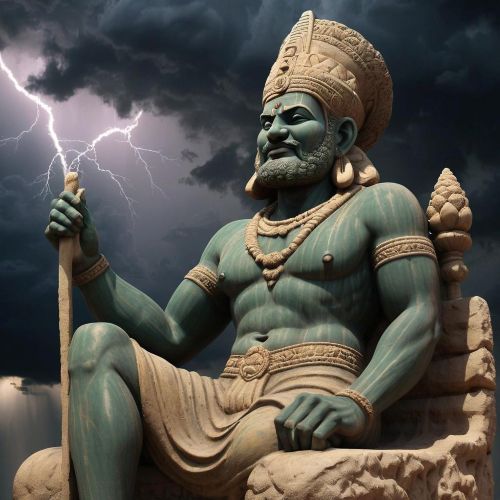
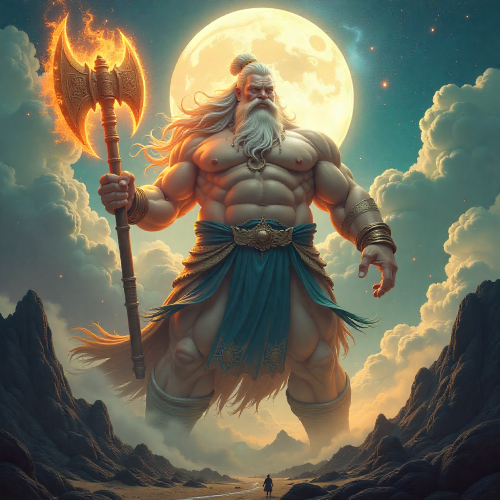
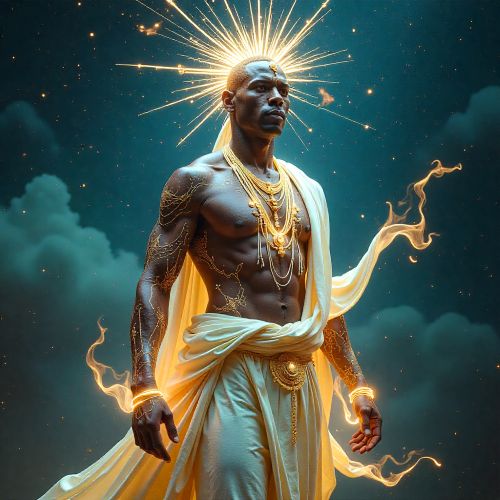
In classical depictions and oral traditions, Sang Je is portrayed as an aged yet majestic being — a divine patriarch of the cosmos. He is often envisioned seated upon a radiant jade throne amidst drifting clouds, symbolizing his supreme position above all creation. His flowing robes shimmer with celestial hues of white, blue, and gold, representing purity, infinity, and divine authority. A long, silver-white beard adorns his face, reflecting timeless wisdom and compassion.
Unlike gods of war or fertility, Sang Je’s physical form embodies serenity rather than power. His visage is calm, his eyes described as radiant stars that observe all realms. Korean folk paintings (minhwa) sometimes depict him surrounded by heavenly attendants or phoenix-like birds, further emphasizing his connection to purity and transcendence. He is rarely shown in motion — instead, his presence alone conveys omnipotence, suggesting that his will itself governs the universe.
Family
Sang Je’s familial structure varies across Korean myths. In the Cheonjiwang Bonpuri, a creation epic from Jeju Island, Sang Je is closely identified with Hwanin, the “Heavenly King” who sends his son Hwanung to rule the earth. This divine descent leads to the legendary birth of Dangun, the first ruler of Gojoseon, Korea’s earliest kingdom. In this sense, Sang Je occupies the role of primordial father — the originator of divine and human lineage.
Though often considered a solitary ruler, Sang Je’s celestial household includes a retinue of gods and spirits who carry out his decrees. He is not a deity of familial warmth but of cosmic hierarchy; his “children” are those who bear divine authority — such as Hwanung or the nature spirits who administer the forces of wind, rain, and light. This symbolic family reinforces the Confucian ideal of ordered relationships — heaven as father, earth as mother, and humankind as the child of both.
Other Names
Sang Je is known by several titles across Korea’s spiritual traditions, each reflecting different cultural lenses and the evolution of belief systems through centuries of syncretism. As Haneulnim (하늘님), he is revered as the “Lord of Heaven,” a title that underscores his supreme status in Korean shamanism, or Muism, where he presides over the celestial realm and maintains balance between the divine and mortal worlds. The name Okhwang Sangje (옥황상제), meaning “Jade Emperor Sang Je,” reflects a period of cultural blending during the Joseon dynasty when Taoist cosmology influenced Korean religious thought, merging the idea of a bureaucratic heavenly order with Korea’s indigenous reverence for the sky.
In older traditions recorded in the Samguk Yusa, Sang Je appears as Hwanin (환인), the “Heavenly King” or “Lord of Light,” who sends his son Hwanung to earth, thereby setting in motion the mythic origins of humankind and the founding of the Korean nation. Other regional variations, such as Cheonwang (천왕) or Cheonjiwang (천지왕), translate to “King of Heaven and Earth,” emphasizing his dominion not just over the celestial sphere but over all aspects of existence.
These titles illustrate a theological progression — from animistic sky worship to the formalized image of a celestial monarch — reflecting Korea’s integration of indigenous spirituality, Confucian order, and Taoist influence. Yet, through every interpretation, one enduring truth remains: Sang Je embodies the living sky itself, a divine consciousness that governs the universe with wisdom, justice, and eternal presence.
Powers and Abilities
As the supreme deity, Sang Je possesses absolute dominion over all realms — heaven, earth, and the underworld. His powers are not confined to elemental manipulation but extend into moral and spiritual governance. He is both creator and regulator, setting the laws of nature, destiny, and righteousness.
In mythic cycles, Sang Je rarely intervenes directly. Instead, he acts through divine agents such as Hwanung, celestial generals, or nature spirits who execute his will. This distance underscores his transcendence — a being too vast to dwell among mortals, yet always watching. He governs the balance between yin and yang, the flow of life force (gi), and the moral consequences of human actions.
Sang Je is also invoked as the arbiter of fate, determining the lifespan, success, and virtue of every being. Korean shamans (mudang) still appeal to him during rituals for harmony, rain, or protection, recognizing his enduring authority as the cosmic lawgiver.
Philosophically, his powers mirror the Korean understanding of universal interdependence: heaven provides order, earth nurtures life, and humanity acts as the moral link between them. Sang Je’s governance thus ensures that this triadic balance remains unbroken.
Modern Day Influence
Though Korea has become largely secular and modernized, Sang Je’s essence endures in religious symbolism, art, and cultural consciousness. In Korean shamanism (Muism), the Haneulnim or Heavenly Lord remains the ultimate deity invoked in major rituals. Even within Cheondoism, a modern religious movement inspired by shamanic roots and Confucian morality, Sang Je is equated with Cheonju — the “Lord of Heaven” guiding all creation.
In popular culture, Sang Je’s archetype reappears in films, novels, and television dramas that reinterpret traditional mythological motifs. Characters modeled after him often represent divine authority or cosmic justice, bridging ancient spirituality with modern storytelling. His image has even influenced depictions of celestial rulers in Korean fantasy literature and games, where he symbolizes order amid chaos.
Moreover, the reverence for the sky (Haneul) — whether as metaphor, prayer, or cultural idiom — traces directly back to Sang Je’s mythic legacy. Koreans still use expressions like “By the Heavens” (Haneul-i doatda) to invoke truth or moral integrity, echoing the ancient belief that the heavens watch over human deeds.
Sang Je thus persists not only as a mythological relic but as a timeless symbol of balance, virtue, and divine governance — an ever-present reminder that the heavens remain just, omniscient, and eternal.
Related Images


 What Were Odin’s Riddles, and Why Were They Deadly?
 Akan Caribbean Mythology: African Beliefs That Crossed the Atlantic
 Why the Solar Solstice marked the most powerful days of the ancient world
 Solar Equinox in Ancient Belief: Light, Darkness and Divine Harmony
 Saptamatrika : The Seven Mother Goddesses Who Shape Cosmic Power



Source
Bierhorst, J. (1990). The mythology of Mexico and Central America. New York, NY: William Morrow Paperbacks.
Grayson, J. H. (2002). Myths and legends from Korea: An anthology of traditional tales. Richmond, UK: Curzon Press.
Lee, P. H. (Ed.). (1996). Sourcebook of Korean civilization: Volume 1. New York, NY: Columbia University Press.
Nelson, S. M. (2003). Korean shamanism: The cultural paradox. Seoul, South Korea: Jimoondang Publishing Company.
Wikipedia. (n.d.). Sangje. In Wikipedia: The Free Encyclopedia. Retrieved November 7, 2025, from https://en.wikipedia.org/wiki/Sangje
Encyclopaedia Britannica. (n.d.). Haneulnim: Korean sky deity. In Britannica. Retrieved November 7, 2025, from https://www.britannica.com/topic/Haneulnim
ResearchGate. (n.d.). The concept of Haneul in Korean cosmology. Retrieved November 7, 2025, from https://www.researchgate.net
Yoon, Y. S. (2015). Korean mythological cosmology and its Taoist parallels. Journal of East Asian Religious Studies, 22(3), 45–62. University of Seoul Press.
Frequently Asked Questions
Who is Sang Je in Korean mythology?
Sang Je is the supreme god in Korean mythology, often regarded as the creator of the universe and the ruler of heaven. He is associated with the sky, order, and the moral authority of the cosmos. Sang Je is considered the father of various deities in the Korean pantheon.
What are the key attributes of Sang Je?
Sang Je embodies qualities such as wisdom, justice, and omnipotence. He is often depicted as a benevolent figure who oversees the natural and spiritual worlds, ensuring harmony and balance. His authority extends over other gods and spirits in Korean mythology.
How is Sang Je worshipped in Korea?
Worship of Sang Je typically involves rituals and ceremonies conducted by shamans or during traditional festivals. Offerings and prayers are made to seek his blessings and guidance for prosperity and protection. His reverence is evident in various cultural practices and religious beliefs.
What role does Sang Je play in Korean creation myths?
In Korean creation myths, Sang Je is credited with the creation of the earth, sky, and all living beings. He is often depicted as having brought order out of chaos, establishing the foundations for human civilization. His actions set the stage for the emergence of other deities and mythical figures.
How does Sang Je compare to other deities in Korean mythology?
Sang Je is considered the highest deity, similar to figures like the Jade Emperor in Chinese mythology or Zeus in Greek mythology. While other deities serve specific functions within the pantheon, Sang Je represents overarching authority and creation. His position underscores the importance of hierarchy in Korean mythological traditions.