Kamohoaliʻi : The Hawaiian Shark Guardian of the Ocean
Listen
At a glance
| Description | |
|---|---|
| Origin | Hawaiian Mythology |
| Classification | Gods |
| Family Members | Pele, Hiʻiaka, Nāmaka (Siblings), Haumea (Mother), Nanaue (Son) |
| Region | Hawaii |
| Associated With | Ocean guardianship, Shark deities, Navigation, Protection, Shapeshifting |
The Mythlok Perspective
Kamohoaliʻi represents a departure from the traditional humanised deity. Within the Mythlok framework, he is understood less as a god who governs the sea and more as the ocean itself choosing to be known. Unlike Mediterranean deities such as Poseidon or Neptune, shaped in the human image to be bargained with, Kamohoaliʻi remains fundamentally elemental. While he shares the predatory divinity of the Fijian shark god Dakuwaqa, he is defined by his sacred role as a navigator, marking the limits of human dominion.
Kamohoaliʻi
Introduction
Kamohoaliʻi is one of the most complex and revered oceanic deities in Hawaiian tradition, embodying the living spirit of the sea through the form of a divine shark. Known widely as the shark god and remembered as the elder brother of Pele, he represents the deep respect ancient Hawaiians held for the ocean as both a source of life and a realm of danger. In a culture shaped by voyaging, fishing, and island survival, Kamohoaliʻi stood as a supernatural guide whose presence could mean safe passage or catastrophic loss. His stories reveal how sharks were never viewed merely as predators but as sacred beings capable of protection, guidance, and ancestral guardianship. Through Kamohoaliʻi, the ocean itself becomes a conscious force that responds to reverence, ritual, and moral balance.
Physical Traits
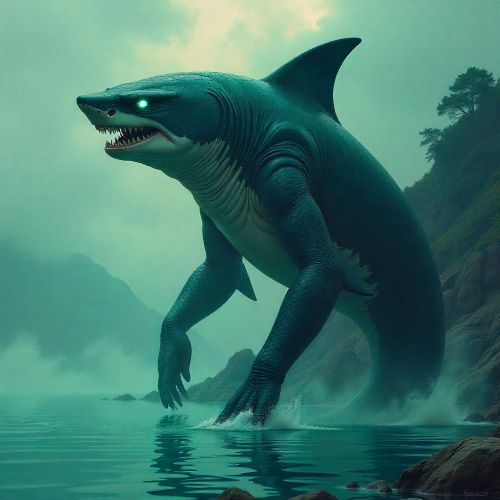
Kamohoaliʻi most commonly manifests as an immense shark whose size and presence exceed that of any natural creature. Oral traditions describe him as commanding and unmistakable, moving through the sea with deliberate authority rather than mindless ferocity. His scales are often said to shimmer in sunlight, marking him as divine rather than animal. Beyond this fearsome form, he possesses the rare ability to transform into other fish or assume a humanoid shape when interacting with gods or mortals on land. In his human form, he appears as a high-ranking aliʻi, a chiefly figure whose gaze and bearing still hint at his oceanic origin. This ability to cross boundaries between sea and shore reinforces his role as a mediator between worlds.
Family
Kamohoaliʻi belongs to one of the most powerful divine lineages in Hawaiian cosmology. He is counted among the children of Haumea, the primordial mother associated with earth and fertility, placing him firmly within the sacred family that governs elemental forces. His siblings include Pele, whose volcanic power reshaped the islands, Hiʻiaka, associated with healing and hula, and Nāmaka, the sea goddess whose conflicts with Pele shaped many coastal legends. Kamohoaliʻi’s relationship with Pele is especially significant, as he repeatedly acts as her protector and guide during her journeys across the ocean. He is also remembered as the father of Nanaue, a semi-divine figure whose inherited shark nature became a cautionary tale about uncontrolled appetite and moral restraint.
Other names
The name Kamohoaliʻi itself carries layered meaning, often translated as “the shark chief” or “king of sharks,” emphasizing both his sovereignty and his sacred status. Variations of his name appear in chants and regional traditions, sometimes rendered as Ka-moho-aliʻi to highlight his chiefly rank. In certain coastal areas, he is also remembered through place-based epithets tied to the channels between Maui and Kahoʻolawe, waters believed to be under his watch. While he is sometimes mentioned alongside other shark spirits such as Ukupanipo, Kamohoaliʻi remains distinct for his close association with navigation, divine kinship, and protective intent rather than control over fishing abundance alone.
Powers and Abilities
Kamohoaliʻi’s abilities reflect the full spectrum of the ocean’s nature. His most renowned power is shapeshifting, which allows him to move freely between forms and observe human activity without detection. As a master of currents and tides, he could guide canoes safely through treacherous waters or lead entire fleets toward land by signaling with powerful movements of his tail. Hawaiian navigators believed that ritual offerings of awa secured his favor, ensuring protection during long voyages. At the same time, he possessed the authority to punish arrogance and disrespect, unleashing storms or misdirection upon those who violated the sanctity of the sea. This balance of mercy and discipline defines him as both guardian and enforcer of oceanic law.
Modern Day Influence
Kamohoaliʻi continues to hold cultural relevance in Hawaiʻi today, not as a distant myth but as a living symbol of ancestral memory and environmental responsibility. Sharks are still regarded as aumakua, family guardians who watch over descendants, and this belief is deeply rooted in his legacy. His stories are preserved through hula, storytelling, and educational programs that emphasize respect for marine life and traditional ecological knowledge. In modern literature, visual art, and even conservation movements, Kamohoaliʻi is often invoked as a reminder that the ocean is not a resource to be exploited but a relative to be honored. For many Hawaiians, his presence endures in the waves, reinforcing the sacred bond between people, ancestors, and the sea.
Related Images


 What Were Odin’s Riddles, and Why Were They Deadly?
 Akan Caribbean Mythology: African Beliefs That Crossed the Atlantic
 Why the Solar Solstice marked the most powerful days of the ancient world
 Solar Equinox in Ancient Belief: Light, Darkness and Divine Harmony
 Saptamatrika : The Seven Mother Goddesses Who Shape Cosmic Power




Source
Beckwith, M. (1970). Hawaiian mythology. University of Hawaii Press. (Cited in ulukau.org collections)
History Cooperative. (2024). The Hawaiian gods: Māui and 9 other deities. https://historycooperative.org/hawaiian-gods/
Pono, J. (2019). The Shark King [Graphic novel]. BeachHouse Pictures.
Strong Washburn, K. (2020). Sharks in the time of saviors. Flatiron Books.
Westervelt, W. D. (1916). Hawaiian legends of ghosts and ghost-gods. George H. Ellis Press. (Accessed via Hamilton Library, University of Hawaiʻi).
Wikipedia. (2024). Kāmohoaliʻi. https://en.wikipedia.org/wiki/K%C4%81mohoali%CA%BBi
Wyatt, L. R. (2024). The shark deities and spirits of Hawaiʻi.
https://lewisrhystwiby.wordpress.com/2024/07/14/the-shark-deities-and-spirits-of-hawaii/
Shark Stewards. (2024). Hawaii’s spiritual connection to the shark. https://sharkstewards.org/hawaiis-spiritual-connection-to-the-shark/
Fornander, A. (1916-1920). Fornander Collection of Hawaiian Antiquities and Folk-lore (Vols. 4-6). Bishop Museum Press.
Hawaiian Ethnobotany Online Database. (n.d.). Kamohoaliʻi. Retrieved from http://www.ethnobotany.org/Kamohoalii.html
Kapiʻolani Community College. (n.d.). Hawaiian Deities. Retrieved from https://www.kapiolani.hawaii.edu/library/research-guides/hawaiian-deities/
Maly, K. (2001). Kahoʻolawe: Na Leo O Kanaloa, The Voices of Kanaloa. Kahoʻolawe Island Reserve Commission.
Frequently Asked Questions
Who is Kamohoaliʻi in Hawaiian belief?
Kamohoaliʻi is a revered shark god associated with ocean navigation, protection, and ancestral guardianship.
Is Kamohoaliʻi related to Pele?
Yes, he is traditionally regarded as Pele’s elder brother and often serves as her protector during ocean journeys.
Why are sharks considered sacred in Hawaiʻi?
Sharks are viewed as aumakua, or family guardians, a belief strongly connected to deities like Kamohoaliʻi.
Did Hawaiians worship Kamohoaliʻi?
Rather than worship in a distant sense, Hawaiians honored him through rituals and respect for the ocean.
Does Kamohoaliʻi still influence Hawaiian culture today?
Yes, his legacy continues through cultural practices, storytelling, and marine conservation values.