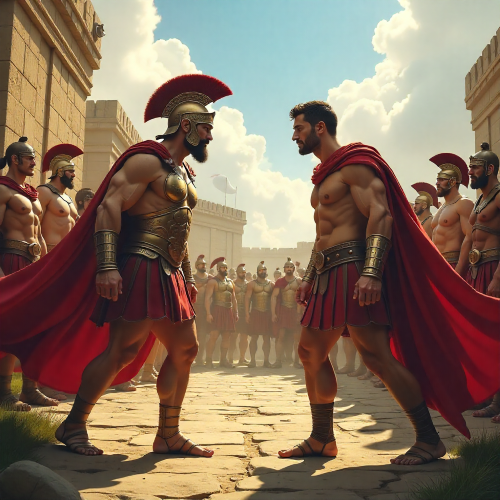
Aeneas : The Trojan Hero
Listen
At a glance
| Description | |
|---|---|
| Origin | Mediterranean Mythology |
| Classification | Demigods |
| Family Members | Anchises (Father), Aphrodite (Mother), Creusa (Wife), Ascanius (Son) |
| Region | Greece, Italy |
| Associated With | War, Bravery |
Aeneas
Introduction
Aeneas, one of the most celebrated figures in Greco-Roman mythology, is remembered as the Trojan hero whose destiny was to establish the foundations of Rome. Born of divine and royal lineage, he was the son of Anchises, a Trojan prince, and Aphrodite, the goddess of love. His legend bridges the fall of Troy and the rise of Rome, making him a crucial link between Greek and Roman traditions. In Homer’s Iliad, Aeneas appears as a warrior favored by the gods, while in Virgil’s Aeneid, his role expands into that of a leader burdened with fate, duty, and sacrifice. His journey across the Mediterranean after the destruction of Troy was not merely a quest for survival but a mission to fulfill a divine prophecy that would give rise to a new civilization. Through him, myths of exile, struggle, and destiny became entwined with Rome’s imperial identity, securing Aeneas’s place as one of the most enduring heroes of classical literature.
Physical Traits
Descriptions of Aeneas’s appearance are scarce in early Greek works, but later accounts and Roman interpretations provide a more complete picture. He is often depicted as noble, dignified, and radiating the beauty of his divine mother, Aphrodite. Virgil emphasizes his godlike presence, describing him as a figure who inspires respect and loyalty among his followers. Some Byzantine sources add more earthly details, portraying him as broad-chested, fair-skinned, and physically strong, with features that reflected endurance rather than perfection. Unlike other mythological figures whose beauty often dominates their image, Aeneas is remembered more for his commanding presence and the aura of responsibility he carried. His physicality was a reflection of his role as both warrior and leader, embodying the strength required to bear the burdens of fate and the resilience to guide his people toward a promised future.
Family
Aeneas’s story is deeply connected to his family, who symbolize both his past in Troy and his future in Italy. His father, Anchises, was central to his journey; Aeneas’s act of carrying the elderly Anchises on his shoulders during the flight from Troy became an enduring image of filial devotion. Anchises also served as a spiritual guide, particularly in the underworld, where he revealed to Aeneas the glorious destiny of his descendants. Aeneas’s mother, Aphrodite, ensured his survival and offered divine aid at crucial moments, reinforcing his role as a child of the gods.
His personal life also shaped the myth. His first wife, Creusa, perished during the escape from Troy, leaving behind a haunting farewell that underscored the inevitability of fate. With her, he fathered Ascanius, also known as Iulus, who would carry forward the Trojan lineage in Italy and become a symbolic ancestor of the Julian family, to which Augustus claimed descent. Later, Aeneas married Lavinia, daughter of King Latinus, solidifying the bond between Trojans and the native Latins. This union not only legitimized his settlement in Latium but also wove together two cultures whose union symbolized the origins of Rome.
Other names
The name Aeneas itself derives from the Greek Aineias, often translated as “praise” or “terrible in battle.” Roman writers expanded on his identity with titles that emphasized his virtues and lineage. He was frequently called pius Aeneas, highlighting his unwavering devotion to duty, family, and the gods. Another common epithet was Anchisiades, meaning “son of Anchises,” a reminder of his noble Trojan heritage. In Roman contexts, he was also known as pater Aeneas, reflecting his role as a father figure not only to his son Ascanius but also to the future Roman people. These titles were not merely ornamental; they reinforced his reputation as a man whose strength lay in loyalty and obedience to divine will. Across Europe, his name evolved into various forms—Enea in Italian, Enéas in Portuguese, and Anej in Slovene—signaling his enduring presence in cultural memory.
Powers and Abilities
As a demigod, Aeneas was gifted with extraordinary abilities that elevated him above ordinary mortals, though he was never portrayed as invincible. His strength, stamina, and resilience made him a formidable warrior, capable of withstanding the hardships of battle and long voyages. The gods frequently intervened on his behalf, protecting him from death and ensuring his survival for the sake of his destiny. Aphrodite, Apollo, and even Poseidon aided him at different points in the Trojan War, signaling the divine importance of his mission.
Yet, Aeneas’s true power was not purely physical. His defining trait was pietas—a uniquely Roman virtue encompassing duty to the gods, loyalty to family, and responsibility to his people. This sense of devotion often required personal sacrifice, as seen in his painful decision to abandon Dido, queen of Carthage, in order to fulfill his destiny in Italy. He also possessed visionary insight, receiving prophetic dreams and messages from the divine that guided his path. In some traditions, his endurance and obedience ultimately earned him a form of divinity, as Venus petitioned Jupiter to grant her son godhood after his death. In this way, Aeneas’s legacy straddled the human and divine worlds, embodying the balance of mortal struggle and divine purpose.
Modern Day Influence
The legacy of Aeneas has endured for centuries, shaping literature, art, and cultural identity. Virgil’s Aeneid became one of the most influential texts in Western history, studied not only as an epic poem but also as a political and moral allegory during the Augustan Age. Through Aeneas, Rome traced its origins to Troy, giving Augustus and his dynasty a divine and heroic ancestry. This connection ensured that Aeneas remained central to Roman identity and imperial propaganda.
In literature, his story has echoed across eras. Medieval authors reinterpreted him through Christian and chivalric lenses, sometimes casting him as a hero, and at other times portraying him negatively, particularly in relation to Dido. Renaissance dramatists such as Christopher Marlowe explored the tragedy of Dido and Aeneas, highlighting the tension between love and duty. In modern times, poets and novelists continue to revisit his tale, often framing it as a story of exile, migration, and the search for belonging—universal themes that remain strikingly relevant.
Art has also preserved his image. From Pompeian frescoes to Renaissance canvases, Aeneas’s escape from Troy with Anchises on his back became an emblem of endurance and piety. Sculptures, paintings, and architectural reliefs across Europe celebrated his role as a cultural ancestor of Rome. Even today, exhibitions and public monuments revisit his story, using his myth to symbolize resilience in the face of catastrophe.
Contemporary scholarship and media reinterpret Aeneas in fresh contexts. Some see him as a symbol of migration and cultural blending, reflecting modern concerns about identity and displacement. Others draw parallels between his duty-bound sacrifice and the responsibilities of leadership in times of crisis. His mythic voyage has even been retraced in modern projects, connecting ancient Mediterranean routes to present-day heritage and tourism. While Aeneas may not dominate popular films or television in the way Achilles or Hercules do, his influence quietly persists, shaping discussions of civilization, destiny, and cultural memory.
Related Images


 What Were Odin’s Riddles, and Why Were They Deadly?
 Akan Caribbean Mythology: African Beliefs That Crossed the Atlantic
 Why the Solar Solstice marked the most powerful days of the ancient world
 Solar Equinox in Ancient Belief: Light, Darkness and Divine Harmony
 Saptamatrika : The Seven Mother Goddesses Who Shape Cosmic Power





Source
Britannica. (2025). Aeneas. Retrieved from https://www.britannica.com/topic/Aeneas
World History Encyclopedia. (n.d.). Aeneas. Retrieved from https://www.worldhistory.org/Aeneas/
Greek Mythology. (n.d.). Aeneas. Retrieved from https://www.greekmythology.com/Myths/Heroes/Aeneas/aeneas.html
Wikipedia. (2025). Aeneas. Retrieved from https://en.wikipedia.org/wiki/Aeneas
StudyCorgi. (2024). Aeneas’s Characteristics in Aeneid by Virgil. Retrieved from https://studycorgi.com/aeneass-characteristics-in-aeneid-by-virgil/
CliffsNotes. (n.d.). Aeneas Character Analysis. Retrieved from https://www.cliffsnotes.com/literature/a/aeneid/character-analysis/aeneas
TheCollector. (2025). Aeneas’s Family: Parents, Children, and Legacy. Retrieved from https://www.thecollector.com/aeneas-family-parents-children-legacy/
Marvunapp. (n.d.). Aeneas (Trojan War hero). Retrieved from http://www.marvunapp.com/appendix/aeneas.htm
Roman Mythology Worldwide. (2025). The Aeneid’s Influence on Modern Literature. Retrieved from https://roman.mythologyworldwide.com/the-aeneids-influence-on-modern-literature-a-lasting-impact/
Literary Hub. (2025). Emily Wilson Explores The Aeneid’s Influence. Retrieved from https://lithub.com/emily-wilson-explores-the-aeneid-s-influence-on-the-contemporary-western-world/
Aeneas Route. (n.d.). Aeneas Today: Aeneas’ Journey in Contemporary Literature. Retrieved from https://www.aeneasroute.org/en/aeneas-today-aeneas-journey-in-contemporary-literature/
DeepMind. (2025). Aeneas Transforms How Historians Connect the Past. Retrieved from https://deepmind.google/discover/blog/aeneas-transforms-how-historians-connect-the-past/
Frequently Asked Questions
What is lorem Ipsum?
I am text block. Click edit button to change this text. Lorem ipsum dolor sit amet, consectetur adipiscing elit. Ut elit tellus, luctus nec ullamcorper mattis, pulvinar dapibus leo.
What is lorem Ipsum?
I am text block. Click edit button to change this text. Lorem ipsum dolor sit amet, consectetur adipiscing elit. Ut elit tellus, luctus nec ullamcorper mattis, pulvinar dapibus leo.
What is lorem Ipsum?
I am text block. Click edit button to change this text. Lorem ipsum dolor sit amet, consectetur adipiscing elit. Ut elit tellus, luctus nec ullamcorper mattis, pulvinar dapibus leo.
What is lorem Ipsum?
I am text block. Click edit button to change this text. Lorem ipsum dolor sit amet, consectetur adipiscing elit. Ut elit tellus, luctus nec ullamcorper mattis, pulvinar dapibus leo.
What is lorem Ipsum?
I am text block. Click edit button to change this text. Lorem ipsum dolor sit amet, consectetur adipiscing elit. Ut elit tellus, luctus nec ullamcorper mattis, pulvinar dapibus leo.