
Adlet : The Bloodborn Hunters of the Arctic
Listen
At a glance
| Description | |
|---|---|
| Origin | Inuit Mythology |
| Classification | Hybrids |
| Family Members | Niviarsiang (Mother), Ijirqang (Father) |
| Region | Greenland, Hudson Bay |
| Associated With | Werewolves |
Adlet
Introduction
Among the chilling legends of Inuit mythology, few are as haunting as the tale of the Adlet — fierce, half-human, half-canine beings said to roam the icy tundra. Often called “Inuit werewolves” by outsiders, the Adlet embody the clash between civilization and wilderness, order and chaos. Their story, rooted in oral traditions of the Arctic peoples, warns of imbalance and the consequences of breaking sacred boundaries between humans and the animal world.
The Adlet legend, passed down by storytellers across Greenland, Canada, and Alaska, recounts how these creatures were born from a union between a human woman and a giant dog. Shunned by their community and forced into exile, the Adlet grew into fast, cunning hunters — both victims and monsters of their tragic origin. Like many mythic figures, they blur the lines between evil and misunderstood, reflecting the harsh moral landscape of the North where survival often defied human norms.
Physical Traits
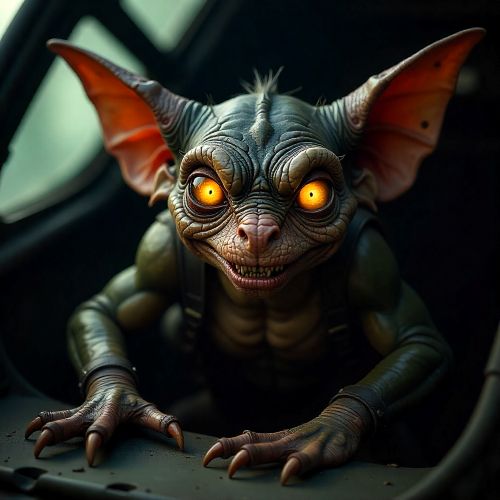
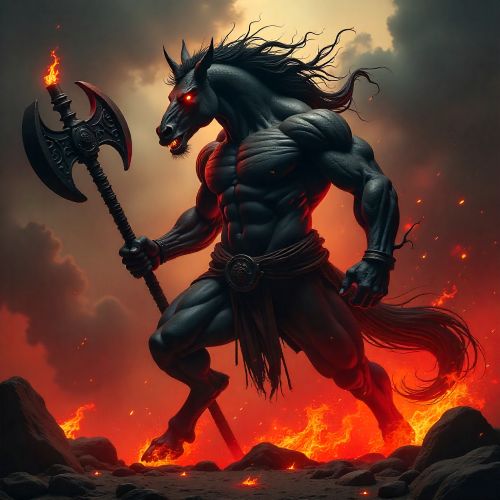
Descriptions of the Adlet vary among Inuit groups, but they are commonly depicted as humanoid figures with canine legs and features, standing upright yet moving with animal-like speed. Their bodies are covered in thick fur to withstand the cold, their faces a blend of human intelligence and wolfish ferocity. In some versions, they possess elongated limbs and blood-red eyes that glow in the dark, marking them as beings born of both man and beast.
Unlike the European werewolf, the Adlet do not transform from human to wolf; they are born hybrid — an entirely different species. Their strength, endurance, and sharp senses make them superb hunters capable of running tirelessly across frozen plains. Some stories even describe their howls echoing across glaciers as omens of misfortune or approaching blizzards. The Adlet’s physical duality serves as a reflection of their inner one: half human reason, half untamed instinct.
Family
The origin of the Adlet begins with a tragic tale involving a lonely Inuit woman and her dog. In this myth, the woman, isolated and yearning for companionship, mates with her faithful dog and bears a litter of ten children — five human-like and five dog-like. The father, ashamed or fearful, is either killed or driven away. The woman’s human family, horrified by the unnatural birth, exiles her and the offspring to the wilderness.
In most retellings, the five dog-like children grow into the Adlet, while the more human ones become ancestors of the European peoples — a symbolic attempt to explain racial and cultural differences through mythic ancestry. In this sense, the Adlet family myth doesn’t just serve as a monster story but as an origin legend that speaks to human diversity and the Inuit worldview of kinship between species.
Other Names
The Adlet are also known by regional variations such as Erqigdlet in certain Inuit dialects or Adlat in Greenlandic lore. While “Inuit werewolf” is a modern label applied by outsiders, it captures the essence of the creature’s hybrid nature in simplified form. The term “Adlet” itself may stem from roots meaning “those of the dogs” or “dog people.”
Across the Arctic, stories of dog-human hybrids vary — some portray them as bloodthirsty aggressors attacking settlements, while others cast them as tragic wanderers longing for acceptance. These naming differences reflect local cultural values: some communities see them as warnings against taboo relationships, while others recognize them as symbols of wild resilience and adaptation.
Powers and Abilities
The Adlet possess extraordinary physical prowess — speed, endurance, and strength beyond any human’s. They are said to run faster than caribou, their legs never tiring, allowing them to pursue prey across vast frozen landscapes. Their heightened senses of smell and hearing make them exceptional hunters, capable of tracking life even through snowstorms.
However, the Adlet’s most defining “power” is their in-between nature. They are neither human nor beast, existing on the threshold of two worlds. Some shamans claimed to communicate with or even command Adlet through ritual, treating them as spirits of vengeance or protectors. Others saw them as cursed beings incapable of redemption, doomed to eternal wandering and hunger.
In moral terms, the Adlet embody uncontrolled instinct — power without harmony. They remind listeners of the danger of breaking cultural and natural boundaries, a recurring lesson in Inuit cosmology where balance between humans, animals, and spirits determines survival.
Modern Day Influences
In modern culture, the Adlet legend continues to capture fascination as one of the Arctic’s most compelling supernatural myths. Anthropologists and folklorists record Adlet tales as part of wider Inuit oral traditions that preserve ecological and moral knowledge. The creature has appeared in modern horror fiction, folklore podcasts, and fantasy media as a symbol of primal fear and cultural hybridity.
Contemporary Inuit storytellers reinterpret the Adlet as metaphors for identity and displacement — beings caught between two worlds, much like Indigenous peoples navigating modern change. Artists and illustrators in Nunavut and Greenland have begun depicting the Adlet in new ways: sometimes monstrous, sometimes soulful, but always powerful.
Interestingly, online communities and social media folklore forums have reintroduced the Adlet to global audiences, often labeling them “Inuit werewolves” in horror lists or myth compilations. Yet, within Inuit cultural education, the legend remains a teaching story about respect for nature, taboo, and consequence — lessons that resonate even beyond the Arctic.
As mythology evolves in the digital age, the Adlet continues to run through the collective imagination — still wild, still watchful, and still whispering warnings carried on the cold northern wind.
Related Images


 What Were Odin’s Riddles, and Why Were They Deadly?
 Akan Caribbean Mythology: African Beliefs That Crossed the Atlantic
 Why the Solar Solstice marked the most powerful days of the ancient world
 Solar Equinox in Ancient Belief: Light, Darkness and Divine Harmony
 Saptamatrika : The Seven Mother Goddesses Who Shape Cosmic Power

Source
Boas, F. (1901). The Eskimo of Baffin Land and Hudson Bay. American Museum of Natural History.
Britannica. (n.d.). Adlet – Inuit mythology. https://www.britannica.com/topic/adlet
Erdoes, R., & Ortiz, A. (1984). American Indian Myths and Legends. Pantheon Books.
Hawker, J. (2019). Creatures of the North: Inuit Legends and Monsters. University of Alaska Press.
Leeming, D. A. (2005). The Oxford Companion to World Mythology. Oxford University Press.
Rasmussen, K. (1921). Myths and Tales from East Greenland. Gyldendal.
Smith, M. (2018). Spirits of the Snow: Inuit Belief and Survival. Polar Studies Review.
Wikipedia contributors. (n.d.). Adlet (mythology). https://en.wikipedia.org/wiki/Adlet
Frequently Asked Questions
What does the Adlet look like?
The Adlet, a creature from Inuit mythology, is a man-dog hybrid with a fiery red or brown fur-covered human-like upper body, a long snout, pointed ears, and piercing yellow eyes. Its lower body boasts powerful canine legs, a long tail, and claws. Standing up to eight feet tall, the Adlet is strong, agile, and boasts superior senses. While often portrayed as aggressive and dangerous, some stories depict them as protectors or guardians.
What is the native mythology of Greenland?
Greenland’s native mythology, deeply rooted in animism and respect for nature, features a captivating spirit world populated with mythical creatures like the vengeful Qivittoq and the powerful Adlet. These stories served to explain natural phenomena, teach moral lessons, and provide entertainment, fostering a strong cultural identity. While the world has evolved, Greenlandic mythology remains relevant, offering valuable insights into the Inuit worldview and reminding us of the interconnectedness of humanity and nature.
What is the adlet in the Inuit myth?
In Inuit mythology, the adlet (also known as Erqigdlet) is a race of half-man, half-dog creatures. They are described as having human-like upper bodies with thick fur and dog-like legs.
What is the meaning of adlet?
In Inuit mythology, it refers to a race of half-man, half-dog creatures with thick fur and powerful canine legs. They are often portrayed as aggressive and dangerous, but some versions depict them as protectors or guardians.
What religion is Greenland?
The majority of Greenland’s population (approximately 95.5%) is Christian, primarily belonging to the Church of Denmark, which is Protestant in classification and Lutheran in orientation.



Pingback: The Fascinating Wolf Man of the Inuits – To Contrive & Jive