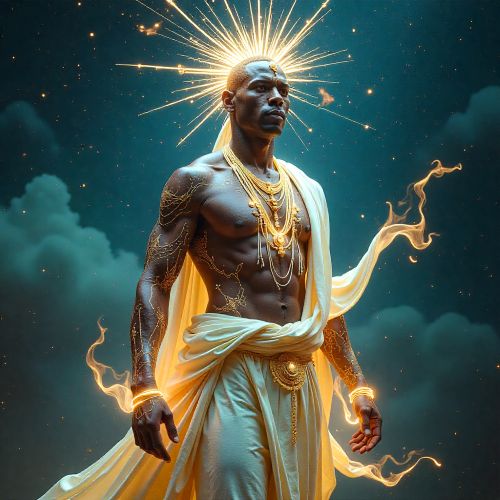
Pangool : Ancestral Spirits of the Serer Tradition
Listen
At a glance
| Description | |
|---|---|
| Origin | Serer Mythology |
| Classification | Spirits |
| Family Members | N/A |
| Region | Senegal, The Gambia, Mauritania |
| Associated With | Ancestral, Protection, Healing, Justice |
Pangool
Introduction
The Pangool occupy a central and enduring place in Serer spiritual thought, representing a sacred bridge between humanity, nature, and the divine order established by Roog, the supreme creator. Found in the traditional belief systems of the Serer people of Senegal, the Gambia, and Mauritania, they are best understood as canonized ancestral spirits and spiritual guardians rather than distant gods. They embody memory, morality, and continuity, preserving the bond between the living community and those who shaped its past. Far from abstract concepts, Pangool are actively present in daily life through ritual observance, sacred geography, and inherited customs that guide social conduct, environmental respect, and spiritual responsibility.
Unlike pantheons built around singular divine figures, the Pangool exist as a plural collective, each associated with specific families, villages, natural features, or historical founders known as Lamanes. Their veneration reflects a worldview in which land, lineage, and spirituality are inseparable. Through them, the Serer articulate a philosophy where ancestral wisdom remains alive, responsive, and protective, ensuring balance between human action and cosmic order.
Physical Traits
Pangool do not possess fixed anthropomorphic forms. Their presence is symbolic, situational, and deeply rooted in the natural world. The most widely recognized symbol associated with Pangool is the serpent, often depicted as two coiled snakes, representing spiritual vigilance, continuity, and liminality between worlds. This imagery connects directly to Serer creation traditions in which serpents and sacred trees mark the earliest manifestations of life and order.
Rather than appearing as physical beings, Pangool manifest through sacred trees, rivers, stones, winds, and dreams. Certain species of trees, particularly those growing near ancestral shrines or burial grounds, are believed to house or channel their presence. In ritual contexts, their essence is invoked through altars, carved objects, libations, and ceremonial spaces rather than visual representation. This absence of a defined body emphasizes their role as forces and guardians rather than personalities, reinforcing the Serer belief that spiritual power is woven into the environment itself.
Family
The concept of family among the Pangool does not follow biological lineage but reflects ancestral affiliation and spiritual inheritance. Each Pangool is linked to a specific clan, village, or lineage, often tracing back to a Lamane who founded or protected a settlement. These ancestral spirits continue to guide their descendants, reinforcing moral behavior and communal obligations.
Serer tradition distinguishes between paternal and maternal Pangool, reflecting the importance of both lineage lines in spiritual identity. Not every ancestor becomes a Pangool; canonization occurs only for individuals whose lives embodied exceptional leadership, sacrifice, or spiritual alignment. Once elevated, a Pangool becomes a permanent guardian of their people and land, creating a spiritual family that transcends generations. In this sense, the Serer community itself forms the living extension of the Pangool family, bound by shared memory and responsibility.
Other names
The term Pangool is plural, while Fangool refers to a single spirit. Variations such as Pangol or Fangol appear across different Serer and Cangin dialects, reflecting linguistic diversity rather than doctrinal difference. Some Pangool are identified by personal names, often linked to their historical roles or sacred locations, while others are referenced by their function or domain.
Certain Pangool are categorized by the nature of their rituals and offerings. Milk Pangool are associated with peace, protection, and healing and reject violence or blood offerings. Blood Pangool, by contrast, are invoked for justice, defense, and decisive intervention, accepting animal sacrifice in controlled ritual contexts. These distinctions reflect ethical balance rather than hierarchy, ensuring that spiritual power is exercised appropriately within communal norms.
Powers and Abilities
The powers of the Pangool are practical, relational, and ethically grounded. Their primary role is intercession, acting as messengers between humans and Roog, carrying prayers, offerings, and communal concerns into the divine realm. Through this mediation, Pangool influence health, fertility, rainfall, and social harmony.
Pangool are also protectors, guarding villages, families, and sacred lands against misfortune, disease, and spiritual imbalance. They serve as moral regulators, responding to disrespect toward elders, land, or tradition with corrective consequences rather than arbitrary punishment. Healing is another major domain, with specific Pangool associated with herbal knowledge, childbirth, and recovery from illness.
Rather than granting miracles on demand, Pangool require reciprocity. Offerings, taboos, and ritual observance maintain the relationship, reinforcing a worldview in which spiritual power responds to responsibility rather than devotion alone.
Modern Day Influence
Despite centuries of Islamic and Christian presence in West Africa, Pangool veneration remains a vital element of Serer identity. Sacred groves, shrines, and ancestral trees continue to be protected, often even by Serer families who practice monotheistic religions alongside traditional customs. Annual ceremonies and agricultural rituals still invoke Pangool protection, particularly during planting seasons and community transitions.
In academic discourse, Pangool traditions are increasingly recognized as sophisticated systems of environmental ethics, ancestral memory, and social governance. Artists, writers, and cultural historians draw upon Pangool symbolism to explore themes of continuity, resistance, and indigenous knowledge. Among diaspora communities, renewed interest in Pangool reflects a broader movement toward reclaiming ancestral spirituality as a source of identity and resilience in a globalized world.
Related Images

 What Were Odin’s Riddles, and Why Were They Deadly?
 Akan Caribbean Mythology: African Beliefs That Crossed the Atlantic
 Why the Solar Solstice marked the most powerful days of the ancient world
 Solar Equinox in Ancient Belief: Light, Darkness and Divine Harmony
 Saptamatrika : The Seven Mother Goddesses Who Shape Cosmic Power



Source
Gravrand, H. (1990). La Civilisation Sereer – Pangool (Vol. 2). Les Nouvelles Editions Africaines du Senegal.
Gravrand, H. (1983). La civilisation Sereer: Cosaan – les origines (Vol. 1). Nouvelles Editions africaines.
Kalis, S. (1997). Médecine traditionnelle, religion et divination chez les Seereer Siin du Sénégal – La connaissance de la nuit. L’Harmattan.
Faye, L. D. (1983). Mort et Naissance le monde Sereer. Les Nouvelles Editions Africaines.
Galvan, D. C. (2004). The state must be our master of fire: How peasants craft culturally sustainable development in Senegal. University of California Press.
Wikipedia contributors. (2025). Pangool. Wikipedia. https://en.wikipedia.org/wiki/Pangool
Varner, J. (2015, March). Mythology world tour: The Serer. JeremyVarner.com. http://jeremyvarner.com/blog/2015/03/mythology-world-tour-the-serer/
Richard, F. G. (2019). Peanuts, Pangool, and places: Constellations of colonial capitalism in rural Senegal. Academia.edu. https://www.academia.edu/41157305/
Frequently Asked Questions
What are Pangool in Serer belief?
Pangool are canonized ancestral spirits who act as protectors, moral guides, and intermediaries between humans and the supreme creator.
Why are serpents associated with Pangool?
Serpents symbolize spiritual continuity, vigilance, and the bridge between earthly and divine realms.
Are Pangool gods or spirits?
They are spirits, not gods, rooted in ancestral memory and sacred geography rather than divine creation.
Do Pangool still have followers today?
Yes, Pangool veneration continues through rituals, sacred sites, and cultural practices among Serer communities.
What offerings are made to Pangool?
Offerings vary by Pangool and may include milk, crops, libations, or animal sacrifice depending on ritual context.