Manana Take: The Rapa Nui Goddess of Fertility
Listen
At a glance
| Description | |
|---|---|
| Origin | Rapa Nui Mythology |
| Classification | Gods |
| Family Members | Era Nuku (Husband) |
| Region | Easter Island |
| Associated With | Fertility, Abundance |
Manana Take
Introduction
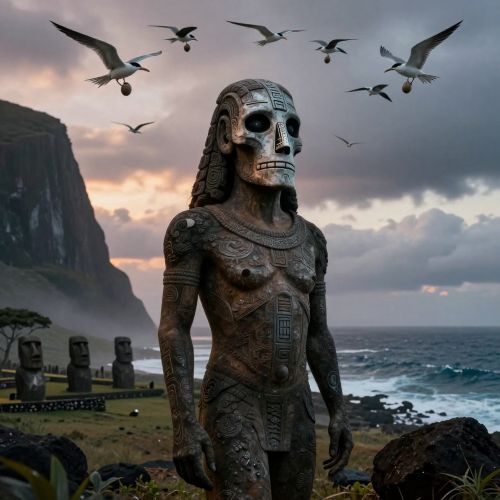
Manana Take occupies a quiet yet meaningful place within Rapa Nui belief systems, reflecting how divine authority, fertility, and nature were understood on Easter Island. Unlike more widely known figures such as Make Make, Manana Take is remembered through fewer surviving traditions, yet her role reveals how power and sanctity were embedded into everyday life. She is described as a sky-dwelling goddess closely linked to abundance and sacred rulership, and most notably as the consort of Era Nuku, the god associated with feathers and farming.
Her myths reflect a worldview in which the sea, sky, and land were inseparable forces governed by spiritual law. Rapa Nui society relied on strict ritual order to survive an isolated and resource-limited environment, and Manana Take’s presence reinforces this structure. Through her transformation into a sacred fish and her connection to royal taboos, she embodies the idea that divine power must remain distinct from ordinary human behavior. Her stories illuminate how cosmology, ecology, and kingship were woven together in Rapa Nui thought.
Physical Traits
Manana Take is not described through fixed human imagery, which aligns with many Rapa Nui deities whose power was expressed symbolically rather than anthropomorphically. She is said to reside in the sky, suggesting a celestial, intangible presence rather than a bodily form. This lack of physical definition emphasizes her divine distance from humanity and her authority over forces beyond human reach.
One of the most striking descriptions of Manana Take appears in a myth where she descends to earth in the form of an enormous and beautiful fish. This transformation is not incidental but central to her identity. The fish embodies abundance, sacred generosity, and supernatural intervention. Its extraordinary nature marked it as divine, reinforcing the belief that the ocean itself was governed by spiritual will rather than human control. Through this aquatic form, Manana Take bridges sky and sea, making her a liminal figure rather than a visible goddess.
Family
Manana Take’s most clearly recorded relationship is her union with Era Nuku, a god associated with feathers, agriculture, and sustenance. This pairing reflects an essential balance in Rapa Nui cosmology: sky-based fertility joined with earth-based nourishment. Era Nuku’s domain over farming and feathers complemented Manana Take’s celestial authority, creating a divine partnership responsible for abundance and order.
No children are explicitly attributed to Manana Take in surviving accounts, which is not unusual in Rapa Nui traditions where divine function often outweighs genealogy. Her role as consort places her firmly within the sacred hierarchy without requiring extensive lineage. This focus on partnership rather than descent mirrors how authority on the island was reinforced through ritual roles rather than bloodlines alone.
Other names
Manana Take appears to retain a singular name within known Rapa Nui traditions. Unlike many Polynesian deities whose identities spread across islands under different names, her worship seems to have been localized. This suggests that her cult was specific to Easter Island rather than part of a broader pan-Polynesian framework.
The name itself carries symbolic weight. Scholars often associate “Take” with strength, foundation, or authority, while “Manana” may echo concepts related to mana, the sacred force believed to inhabit divine beings, rulers, and places. The absence of alternate names reinforces her role as a focused and distinct spiritual presence rather than a widely adapted archetype.
Powers and Abilities
Manana Take’s powers are expressed through symbolism, ritual consequence, and transformation rather than warfare or domination. Her most significant ability is shapeshifting, demonstrated by her descent as a divine fish. This act established her authority over marine abundance and reinforced the sacred nature of the sea.
One lasting outcome of her myth was the prohibition placed upon kings, who were forbidden from swimming in the ocean. This restriction reinforced the belief that rulers carried divine essence and must remain separate from common activities. Through this taboo, Manana Take shaped social hierarchy and ritual purity.
Her association with Era Nuku further connects her to fertility, food security, and prosperity. As a sky-dwelling goddess, she also represents oversight and balance, ensuring that natural and social systems functioned in harmony when divine laws were respected.
Modern Day Influence
Manana Take remains largely absent from mainstream representations of Easter Island, which often focus exclusively on the moai. However, within cultural revitalization movements, figures like her are increasingly revisited to recover the deeper spiritual narratives of Rapa Nui heritage. Her story offers insight into how authority, environment, and belief once operated as a unified system.
Her transformation into a sacred fish resonates strongly in contemporary discussions of ocean conservation and environmental respect. For many Rapa Nui cultural practitioners and scholars, her myth symbolizes the idea that nature is not a resource to dominate but a sacred domain governed by ancestral law. Through academic research, artistic reinterpretation, and cultural festivals, Manana Take continues to serve as a reminder that spiritual identity on the island extends far beyond stone monuments.
Related Images
 What Were Odin’s Riddles, and Why Were They Deadly?
 Akan Caribbean Mythology: African Beliefs That Crossed the Atlantic
 Why the Solar Solstice marked the most powerful days of the ancient world
 Solar Equinox in Ancient Belief: Light, Darkness and Divine Harmony
 Saptamatrika : The Seven Mother Goddesses Who Shape Cosmic Power




Source
Edwards, E., & Edwards, A. (2013). When the universe was an island. Empresa Editora Horizonte.
Heyerdahl, T. (1958). Aku-Aku: The secret of Easter Island. Allen & Unwin.
Hunt, T. L., & Lipo, C. P. (2011). The statues that walked: Unraveling the mystery of Easter Island. Free Press.
Métraux, A. (1940). Ethnology of Easter Island (Bishop Museum Bulletin 160). Bernice P. Bishop Museum.
Routledge, K. (1919). The mystery of Easter Island. Sifton Praed.
Wikipedia. (2025). Manana Take. https://en.wikipedia.org/wiki/Manana_Take
Imagine Rapa Nui. (2022, April 21). Mana Rapa Nui: The supernatural power of Easter Island. https://imaginarapanui.com/en/mana-rapa-nui-the-supernatural-power-of-easter-island/
Cambridge University Press. (2015). Makemake, Moai and the Tangata Manu (Chapter 5). In J. J. Boivin & R. A. Bentley (Eds.), The survival of Easter Island. https://www.cambridge.org/core/books/survival-of-easter-island/makemakemoaiand-thetangata-manu/F97860672D7038195A063BFDFEFC59B0
Rapa Nui Travel Guide. (n.d.). Religion and Beliefs. Retrieved December 17, 2025, from https://rapanuitravelguide.com/rapa-nui/rapa-nui-culture/religion-and-beliefs/
Van Tilburg, J. A. (1994). Easter Island: Archaeology, Ecology and Culture. Smithsonian Institution Press.
Fischer, S. R. (2005). Island at the End of the World: The Turbulent History of Easter Island. Reaktion Books.
Rapa Nui mythology. (n.d.). Archive of Rapa Nui mythology. Retrieved December 17, 2025, from https://ia801400.us.archive.org/11/items/iran_20221115/Rapa_Nui_mythology.pdf
Frequently Asked Questions
Who is Manana Take in Rapa Nui belief?
Manana Take is a sky-dwelling goddess associated with fertility, abundance, and sacred authority in Rapa Nui traditions. She is best known as the consort of Era Nuku and for her divine transformation into a fish.
What is Manana Take associated with?
She is linked to celestial power, marine abundance, fertility, and royal taboos that reinforced sacred kingship.
Why was Manana Take important to Rapa Nui rulers?
Her myth established prohibitions that separated kings from ordinary activities, reinforcing their divine status and ritual purity.
Did Manana Take have a physical form?
She was not described in a fixed human form and is primarily known through symbolic manifestations, especially her appearance as a sacred fish.
Is Manana Take still culturally relevant today?
Yes, her story is revisited in cultural preservation efforts and environmental discussions focused on sacred relationships with nature.